The Iron Curtain and the Hoops: When “Partizani” Stunned the Aristocracy of “Celtic”!

Prologue: The Hermit Fortress and the Sovereign Shock
In the cold, analytical ledger of European continental football, certain fixtures cease to be mere athletic contests and transform into dense, volatile cultural crossroads.
On September 19, 1979, the opening round of the European Cup engineered an encounter that felt profoundly surreal. The reigning Scottish champions, “Celtic”, travelled past the rigid boundaries of the West to enter the Hermit Kingdom of monist Albania,—a closed society hidden behind strict ideological walls. For the visiting Glaswegians, the expedition was less an athletic trip and more a bewildering journey into absolute isolation.
Yet, beneath the heavy shadow of the state apparatus, an extraordinary football match unfolded. Operating with an unyielding collective discipline, “Partizan” did not merely defend their home turf; they orchestrated a tactical masterclass that completely paralyzed the star-studded aristocracy of the visitors.
Across 90 minutes of high-stakes tension, the local underdogs shattered the established continental hierarchy. This is the authentic, third-person chronicle of that legendary afternoon—a story of extreme visa gridlocks, banned western media, hidden food rations, and the magnificent, historic baseline of a provincial triumph.
1. The Border Blackout and the Razor’s Edge
The geopolitical tension surrounding this opening leg materialized the exact moment the European draw was finalized in Switzerland.
Navigating a complete communication blackout, the Albanian authorities flatly rejected modern international travel norms, initiating a severe administrative standoff over roster visas. While “Celtic” formally requested 50 operational entry permits for their traveling contingent, the monist state issued a strict limit of only 36 visas, explicitly completely banning any traveling Western journalists or pressmen from crossing the border.
Stranded without a direct transport line after an initial charter agreement with Yugoslav Airlines collapsed, the Scottish club scrambled to secure an alternative private jet just to fulfill the fixture.
Throughout the gridlock, UEFA administrators remained entirely paralyzed, unable to gather even basic scouting reports on a host team playing behind hermetically sealed borders.
The cultural shock deepened upon arrival at Rinas Airport, where the visitors faced a strict customs regime that actively outlawed any perceived symbols of Western consumer influence.
This ideological vetting led to a bizarre diplomatic crisis over facial hair. Under the state’s standing constitutional rewrite of 1967, beards and long hair were strictly banned nationwide.
Intense pre-flight speculation focused on whether “Celtic”‘s iconic, heavily bearded captain, Danny McGrain, would be forced to shave his face at the customs terminal. Though McGrain’s facial hair ultimately survived the state’s scrutiny without a mandatory trim, the team camp remained highly anxious.
Fearing they might deeply offend their hosts, “Celtic” officials avoided bringing standard corporate team catering crates.
Instead, individual players hid emergency food rations inside their private bags. Danny McGrain packed a loaf of bread, a pack of gammon, and a dozen tea bags, while midfielder Tommy Burns carried a tin of baked beans alongside his own tin opener to survive the weekend.
2. The Silent Stadium and the Architecture of Defiance
On the eve of the match, an extraordinary scene unfolded when several thousand local citizens swarmed the training ground just to watch the Glasgow side conduct their tactical warm-ups.
The massive crowd stood in absolute, respectful silence throughout the session, observing the foreign athletes with a quiet curiosity that stood in stark contrast to the aggressive posture of the state’s feared secret police—the Sigurimi—who monitored the perimeter in their blue uniforms.
When matchday arrived, a raucous, emotionally charged crowd of nearly 30,000 fanatical spectators packed the “Qemal Stafa” National Stadium.
Ticket prices for the monumental event were structured at incredibly low levels for the local working class, converting to a meager 7 pence (1,15 Leke) 14 pence (2.30 Leke) dhe 21 pence (3.50) in British currency.
The pre-match protocol featured another striking deviation from traditional footballing etiquette. Instead of exchanging a standard embroidered club pennant during the official captain’s handshake, “Partizani”‘s skipper, Safet Berisha, presented a bewildered Danny McGrain with a hardback book detailing the history of local architecture.
Denied entry to the country, the Scottish press corps resorted to hiring part-time club directors to transmit raw match reports back to UK newspapers via phone lines. Desperate to find anyone who could bridge the extreme linguistic divide for the upcoming return leg, “Celtic” directors published an urgent plea in the Glasgow press, eventually securing the services of Pauline Phillips, a London lecturer who spoke fluent Albanian. To protect their institutional interests amid the administrative chaos, the visitors also took the extraordinary precaution of adding SFA secretary Ernie Walker directly to their traveling executive party.
3. The Searing Crucible and the Shadow of the Ringers
When the sides finally took the field just before 5:00 PM in searing, oppressive heat, “Celtic” manager Billy McNeill fielded a highly potent lineup featuring
21-year-old goal-scoring starlet George McCluskey, Roy Aitken, and Murdo MacLeod.
However, the host’s team sheet caused immediate administrative confusion among the UEFA delegates. Operating under a long-standing, secretive domestic transfer strategy regularly utilized during European campaigns, “Partizani” had reinforced their roster by recruiting elite “ringers” on short-term loans from rival regional clubs.
To bypass international regulatory scrutiny, the technical staff listed these guest players on official match documentation using only their names while completely omitting their surnames.
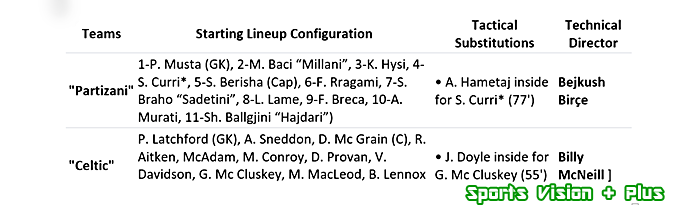
Among the starting eleven, elite figures like Millan Baci, “Millani”; Spiro Curi “Spiro”, Sefedin Braho “Sadedini”, and Shyqyri Ballgjini “Hajdari”, were sourced from the rosters of “17 Nentori” Tirana, “Flamurtari” Vlorë, “Luftëtari” Gjirokastër, and “Dinamo” respectively.
The match opened at a slow, calculated pace as the visitors struggled to adapt to the heavy terrain and blinding low sun. Channeling the immense energy of the home crowd, “Partizani” launched a fierce offensive wave that erupted in the 35th minute.
Seizing a loose, bouncing ball along the right flank, the cerebral Shyqyri Ballgjini unleashed a spectacular, curving cross into the heart of the visitors’ box.

The clinical forward Agim Murati—a dangerous, nimble striker whom the legendary Loro Boriçi had dubbed the “king of the air” due to his magnificent heading technique—rose elegantly above the tracking defense.
Capitalizing on a momentary hesitation by goalkeeper Peter Latchford, who appeared completely blinded by the low sun, Murati powered a magnificent header into the back of the net to trigger absolute bedlam in the grandstands.
The second half turned into a grueling, tight battle of physical attrition. George McCluskey, who had entered the match carrying a severe knee injury picked up against Hibernian, proved completely ineffective in the heat and was replaced by John Doyle in the 55th minute.
The substitution sparked “Celtic”‘s finest tactical spell of the afternoon. Following a fluid combination engineered by MacLeod and Davie Provan, Doyle launched a ferocious, powerful long-range drive that seemed bound for the net, only for the young goalkeeper Perlat Musta to execute a spectacular, world-class flying fingertip save to tip the ball over the crossbar.
From the resulting corner kick, Roy Aitken rose high to fire a powerful header past the keeper, but an alert Red defender cleared the ball directly off the goal line.
The closing stages were defined by intense drama and controversial officiating from Greek referee Nikolaos Zlatanos. After Mike Conroy squandered a golden opportunity by firing wide of the target, the visitors launched a rapid transition that culminated in Vic Davidson turning a sharp Provan cutback into the net.
However, Zlatanos immediately disallowed the equalizer, ruling the play offside—a decision that infuriated the Scottish players and staff on the bench. In the final seconds of the match, as “Partizani” launched a dangerous counter-attack down the right wing, a desperate Danny McGrain was handed a yellow card for a deliberate handball to halt the transition.
While “Celtic” left the pitch convinced they had been deeply unlucky not to escape with a draw, the historic 1–0 scoreline stood firm until the full-time whistle, announcing the return of Albanian club football to the international map through a truly outstanding monument of defiance.
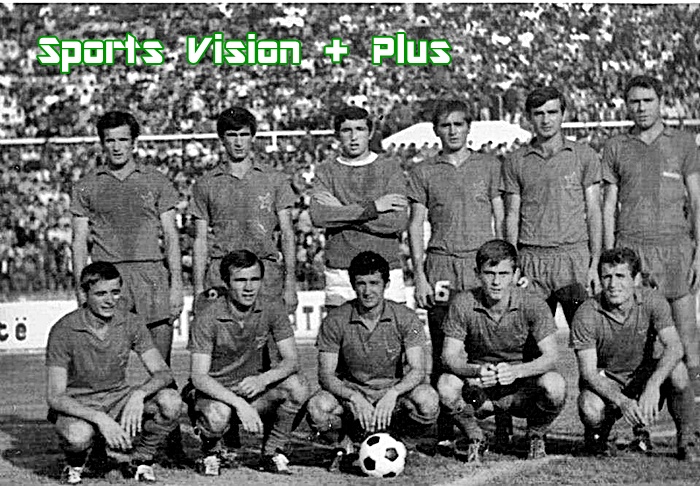
Partizan line up late `70-teis : Hysi, Hametaj; Musta; Lika, Londo, S. Berisha. Hado; F. Rragami; Karriqi, Fagu; Janku
The Historical European Cup Match Ledger
Date & Kick-off:
September 19, 1979 (Just before 17:00 CET)
Venue:
Stadiumi Kombëtar “Qemal Stafa”, Tiranë
Attendance:
~27,500 Spectators (Official Database Standard)
Match Officials:
Referee Nikolaos Zlatanos (Greece)
Scoring
⚽ A. Murati (35′) — Assisted by Sh. Ballgjini
*Short-term guest loan players listed with omitted surnames on official document registries .
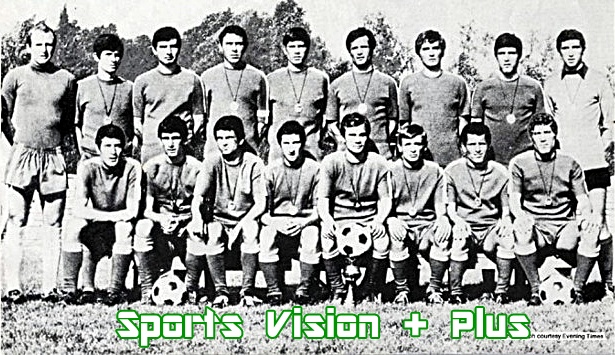
PARTIZAN – ALBANIAN CHAMPIONS 1978-1979 SEASON
Epilogue: The Triumph of the Spirit Over the Titan
The history of human combat is filled with timeless legends where absolute physical power is completely paralyzed by an unyielding inner light—moments where the legendary David, armed with nothing but raw focus and a slingshot, brings the heavy, armor-clad Goliath directly to his knees.
On that unforgettable afternoon in 1979, “Partizani” operated as that exact historical anomaly. On paper, they were a “small” provincial side from a closed country, facing an elite Western titan built on immense professional wealth and global prestige.
Yet, inside the lines, the Scottish giants quickly learned that football matches are not won by the size of a club’s institutional muscles, but entirely dictated by the volume of a team’s collective soul, desire, and unbreakable willpower.
It was a total tactical masterpiece executed by an immortal eleven that refused to be intimidated by the name on the opponent’s jersey. Behind the goalposts, the young Perlat Musta patrolled his , line with a cold, European-caliber authority, turning into an airborne phantom whose spectacular interventions broke the visitors’ spirits.
In front of him, Safet Berisha, Kastriot Hysi, Spiro Curi and Millan Baci the hermetic backline stood like an immovable concrete fortress, tracking every run with a suffocating, aggressive discipline that allowed the Glaswegians zero space to breathe.
In the center circle of midfield sector, Ferid Rragami, Feim Breca and Ilir Lame, were the tireless, iron-lunged engine room fought for every blade of grass, recovering loose balls and launching immediate, sharp transitions to fracture the opposition’s shape.
This relentless work rate fueled a terrifyingly dangerous attacking front, the very fast Sefedin Braho, orchestrated by clever ball distribution and spearheaded by the nimble Agim Murati, who rose into the sky with a poetic majesty to seal a victory that will forever remain a golden monument of athletic defiance.
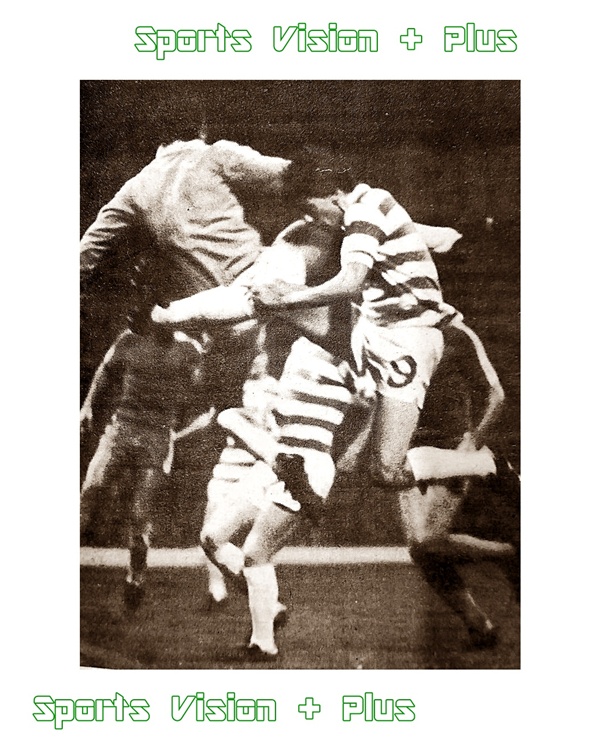
PHOTOS ABOVE FROM THE RETURN MATCH

© Copyright
By Pjerin Bj
Bryant Park, New York City
August 27-30, 2026
_____________________________
Sports Vision +Plus | Champions Hour in activity since 2026

Discover more from Sports Vision +
Subscribe to get the latest posts sent to your email.