The Second Discovery of America!
For Pedro Arispe, homeland meant nothing. It was the place where he was born, which meant nothing to him because he had no choice in the matter. It was where he broke his back working as a peon in a packinghouse, and for him one boss was the same as any other no matter the country.
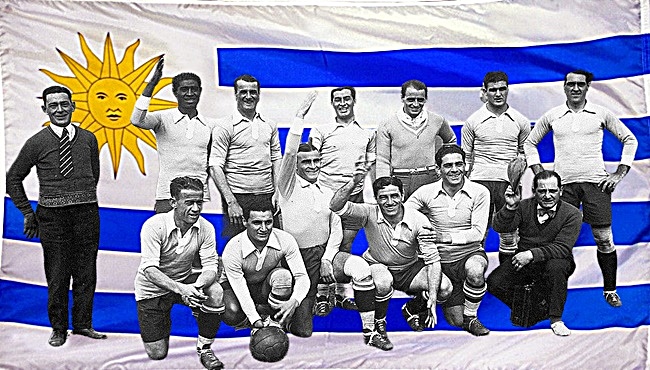
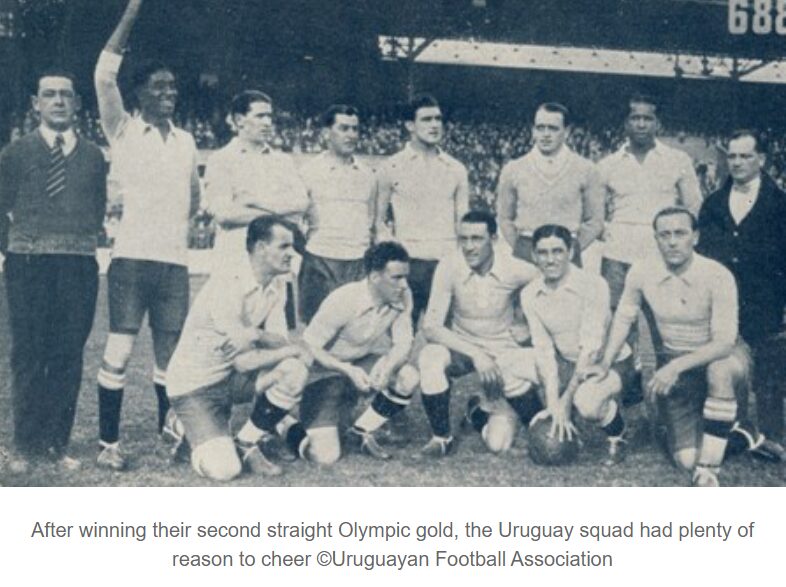
But when Uruguay won the 1924 Olympics in France, Arispe was one of the winning players. While he watched the flag with the sun and four pale blue stripes rising slowly up the pole of honor, at the center of all the flags and higher than any other, Arispe felt his heart burst. Four years later, Uruguay won gold again at the Olympics in the Netherlands.
A prominent Uruguayan, Atilio Narancio, who in 1924 had mortgaged his house to pay for the players’ passage, commented: “We are no longer just a tiny spot on the map of the world.” The sky-blue shirt was proof of the existence of the nation: Uruguay was not a mistake. Soccer had pulled this tiny country out of the shadows of universal anonymity.
The authors of the miracles of ’24 and ’28 were workers and wanderers who got nothing from soccer but the pleasure of playing. Pedro Arispe was a meatpacker. José Nasazzi cut marble. “Perucho” Petrone was a grocer. Pedro Cea sold ice. José Leandro Andrade was a carnival musician and bootblack. They were all twenty years old or a little older, though in the pictures they look like old men. They cured their wounds with salt water, vinegar plasters, and a few glasses of wine.
In 1924 they arrived in Europe in third-class steerage and then traveled on borrowed money in second-class carriages, sleeping on wooden benches and playing match after match in exchange for room and board. Before the Paris Olympics, they played nine matches in Spain and won all nine of them.
It was the first time that a Latin American team had played in Europe. Their first Olympic match was against Yugoslavia. The Yugoslavs sent spies to the practice session. The Uruguayans caught on and practiced by kicking the ground and sending the ball up into the clouds, tripping at every step and crashing into each other. The spies reported: “It makes you feel sorry; these poor boys came from so far away.”
Barely two thousand fans showed up. The Uruguayan flag was flown upside down, the sun on its head, and instead of the national anthem they played a Brazilian march. That afternoon, Uruguay defeated Yugoslavia 7–0. And then something like the second discovery of America occurred. Match after match, crowds lined up to see those men, slippery like squirrels, who played chess with the ball.
The English squad had perfected the long pass and the high ball, but these dis-inherited children, begotten in far-off America, did not walk in their fathers’ footsteps. They chose to invent a game of close passes directly to the foot, with lightning changes in rhythm and high-speed dribbling. Henri de Montherlant, an aristocratic writer, published his enthusiasm: “A revelation! Here we have real soccer. Compared with this, what we knew before, what we played, was no more than a schoolboy’s hobby.”
Uruguay’s success at the ’24 and ’28 Olympics, and its subsequent World Cup victories in 1930 and 1950, owed a large debt to the government’s policy of building sports fields around the country to promote physical education. Now, years later, all that remains of the state’s social calling, and of that great soccer, is nostalgia. Several players, like the very subtle Enzo Francescoli, have managed to inherit and renovate the old arts, but in general Uruguayan soccer is a far cry from what it used to be.
Ever fewer children play it and ever fewer men play it gracefully. Nevertheless,
there is no Uruguayan who does not consider himself a PhD in tactics and
strategy, and a scholar of soccer history. Uruguayans’ passion for soccer
comes from those days long ago, and its deep roots are still alive.
Every time the national team plays, no matter against whom, the country holds its breath. Politicians, singers, and carnival barkers shut their mouths, lovers
suspend their caresses, and flies refuse to budge.
By: Eduardo Galeano “Soccer in Sun and Shadows” (1997)
__________________
Sports Vision +Plus | Champions Hour since 2013

Discover more from Sports Vision +
Subscribe to get the latest posts sent to your email.