
1969: “Dinamo” — A final interrupted off the pitch after 88`!
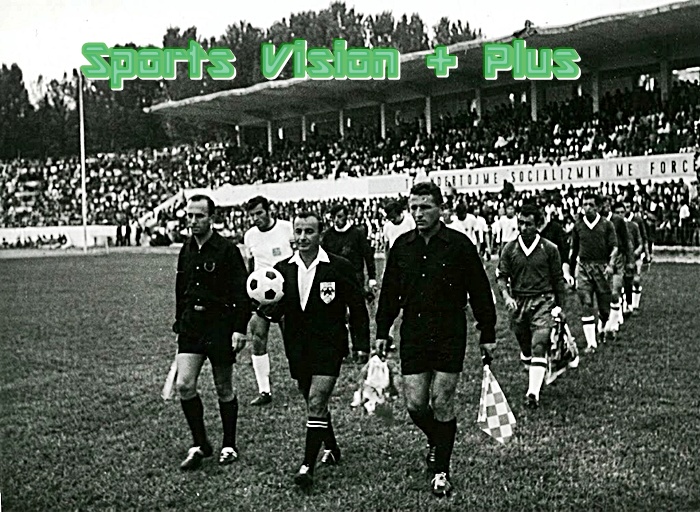
A goal by Bahri Ishka, a journey towards the trophy, and a dramatic evening in Stara Zagora. In 1969, “Dinamo” came within reach of winning the Balkan Cup, but the second leg of the final ended in circumstances that left behind controversy and unanswered questions.
A team with a reputation and ambition
At the conclusion of the 1968 national championship, won
by “17 Nëntori”, “Dinamo” finished in third place with 38 points. The team’s record stood at 18 wins, two draws and six defeats, with a goal difference of 68–28. This result earned the club the right to represent Albanian football in the Balkan Cup.
“Dinamo” came into the competition following an important period, having won the Albanian championship in the 1966–1967 season and continuing to rank among the strongest teams in the country.
Its ranks included several well-known footballers of the time: national-team goalkeeper Koço Dinella, Jani Rama, Iliaz Çeço, Gani Xhafa, Frederik Gjinali, Medin Zhega, Ibrahim Kodra, Taip Çutra, Faruk Sejdini and Maksut Vorfi. Among the names attracting increasing attention was the young forward Ilir Përnaska, who would go on to become one of Albanian football’s recognised goalscorers.
In the 1969 Balkan Cup, “Dinamo” faced Romania’s “Universitatea Craiova” and Yugoslavia’s “Bor”. It was a group in which every match demanded points and consistency, while the Albanian side’s objective was to progress beyond the first stage and go as far as possible in the competition.
The group stage: a winning start
“Dinamo” – “Universitatea Craiova” 2–0
7 May 1969, Tirana — “Dinamo” Stadium
“Dinamo” began its Balkan campaign on 7 May 1969 against the Romanian side “Universitatea Craiova”. In front of approximately 12,000 spectators, the Albanian team produced a good performance and won 2–0, making a positive start to its group campaign.
Medin Zhega broke the deadlock in the 19th minute, while Iliaz Çeço scored the second goal in the 64th minute. With this victory, “Dinamo” collected three important points and sent its first signal that it would be a serious contender for qualification.
The home victory gave the team a good start, but the road to the final would require it to maintain the same rhythm away from home, where every mistake could prove costly.
“Universitatea Craiova” – “Dinamo” 3–1
18 June 1969 — “Central” Stadium, Craiova
In the return match, “Dinamo” faced an opponent determined to make up for its defeat in Tirana. At Craiova’s “Central” Stadium, in front of a large crowd, the Romanian side won 3–1.
Neagu scored in the 26th minute, while Oblemenco doubled the advantage four minutes later. The first half ended with the home side leading 2–0. In the second half, Oblemenco scored again, in the 70th minute, taking the score to 3–0.
“Dinamo” refused to give up and managed to score its only goal in the 79th minute through Taip Çutra. The final score was 3–1 in favour of “Universitatea Craiova”, but the Albanian side remained in contention for qualification.
“Bor” – “Dinamo” 2–2
August 1969, Bor — “Stadion kraj Pirita”
Away against “Bor”, “Dinamo” earned a 2–2 draw in a match that saw the score change several times. The Albanian side took the lead through Medin Zhega, but the hosts responded and turned the score around.
Dušan Sopić equalised, while Slobodan Tomić scored the Yugoslav side’s second goal from the penalty spot. With “Bor” leading 2–1, “Dinamo” faced the prospect of suffering an away defeat.
However, the capital’s team continued to push for a goal and managed to equalise through Faruk Sejdini. The 2–2 result gave “Dinamo” an important point away from home and kept it in contention for first place in the group.

“Dinamo” – “Bor” 4–1
15 August 1969, Tirana — “Qemal Stafa” Stadium
The return match against “Bor” became one of the decisive moments of the group stage. In Tirana, in front of approximately 12,000 spectators, “Dinamo” secured a convincing 4–1 victory and qualified for the Balkan Cup final.

Cutra scored the first goal, while Maksut Vorfi, Medin Zhega and Faruk Sejdini were also on the scoresheet for the Albanian side. Slobodan Tomić scored the only goal for the Yugoslav team (1-1).

The emphatic victory gave “Dinamo” first place in Group A with five points, ahead of “Universitatea Craiova”, who finished with four points, and “Bor”, with three. After a group stage featuring mixed results, the Albanian side had achieved its objective: it would play for the trophy.
It was an important achievement for the club and for Albanian football. Two final matches now stood between “Dinamo” and the trophy, against Stara Zagora’s “Beroe”, winners of the other group.

The first leg of the final: the goal that ignited hope
“Dinamo” – “Beroe” 1–0
22 October 1969, Tirana — “Dinamo” Stadium
The Balkan Cup final began in Tirana on 22 October 1969. Facing “Dinamo” was Bulgaria’s “Beroe”, an opponent seeking to win the trophy but first required to pass the test of the away match in Albania.
The match was important for both teams. In a two-legged final, every goal carried particular weight: a positive result in the first match could create an advantage ahead of the decisive trip to Bulgaria.
“Dinamo” managed to win the match 1–0. Bahri Ishka scored the decisive goal, giving the Albanian side an advantage ahead of the return leg.
One goal was all that separated “Dinamo” from a genuine opportunity to lift the trophy. But the narrow margin allowed no room for complacency. In Stara Zagora, the team would have to withstand the pressure from the home side and defend the advantage earned in Tirana.
The final was still open. The trophy had not yet been won, but Albanian hopes remained alive.
The second leg: a final that did not end normally
The return final!
It is one of the most mysterious and contradictory finals, perhaps among the finals of any trophy in world football, regardless of the importance of the trophy itself.
It is 29 October 1969. In Stara Zagora, Bulgaria, the second leg of the final between the home side “Beroe” and Albania’s “Dinamo” is scheduled to take place.
“Dinamo” won the first leg 1–0 with a goal by B. Ishka. In front of slightly more than 13,000 Bulgarian spectators, both teams take to the pitch under the direction of the chief referee, Yugoslav official Zecevic.
In the 20th minute, the hosts take the lead through Nikola Ivanov. 1–0!
After the goal, the match continued at an intense pace. “Dinamo” tried to maintain its organisation and prevent the hosts from taking complete control of the game, while “Beroe” sought the goal that would give it the advantage on aggregate.
After that, the match took on the character of a genuine battle. “Dinamo” resisted and maintained its discipline, while “Beroe”, despite its persistence, failed to show efficiency in front of goal. The closing minutes were dramatic, particularly when the referee awarded a penalty to the home side. The Albanians, however, strongly disagreed and, following heated arguments, left the pitch in anger, refusing to accept the decision of the Yugoslav referee.
What is known and what remains unclear
According to a historical source from “Beroe” club, events unfolded as follows: In the return leg, “Beroe” took the lead in the 20th minute through Nikola Ivanov. The 1–0 score remained unchanged until the end of normal time. In the closing minutes, Yugoslav referee Zecevic awarded a penalty to “Beroe”. The “Dinamo” players protested and left the pitch.
The match did not end normally, and “Beroe” was awarded a 3–0 administrative victory, winning the trophy with an aggregate
score of 3–1.
In a retrospective published in December 1969, “Sportul” wrote that the Albanian players withdrew from the pitch in the 88th minute, when Yugoslav referee Zecevic awarded a penalty to “Beroe”. However, the article gives the score at that moment as 1–1!!!
This detail does not match the account from “Beroe”, RSSSF and the competition’s historical record, all of which give the score as 1–0 at the moment the match was interrupted.
And the final element that remains a conspiracy in this entire episode is a modern version claiming that “Dinamo” never travelled to Bulgaria for political reasons!!!
Meanwhile, other sources state that “Dinamo” withdrew in the closing minutes following the award of a penalty…
What remains official is the archival record:
“Beroe” – “Dinamo” 3–0, awarded after the Albanian players left the pitch when the score was 1–0.
Date: 29 October 1969
Venue: Stara Zagora, Bulgaria
Stadium: “Beroe”
Spectators: 13,000
Referee: Zecevic (Yugoslavia)
Goalscorer: 20′ Ivanov
Line-ups: —
The conclusion of the final is recorded in the competition’s history: “Dinamo” won the first leg 1–0, while the return match was recorded as a 3–0 victory for “Beroe” after the Albanian team left the pitch, at a moment when the home side were leading 1–0 and a penalty had been awarded.
Nevertheless, some details in later accounts do not match. One version places the departure of the Albanian players in the 88th minute, while another gives the score as 1–1 at that moment. This does not correspond to the recorded on-field score of 1–0 for “Beroe” or to the administrative result of 3–0. For this reason, the 1–1 score cannot be presented as a confirmed fact.
The complete official line-ups for both final matches have also not been established by the available documentation. The names of the footballers who represented “Dinamo” during the 1968–1969 season help reconstruct the composition of the team, but they should not be presented as the confirmed line-ups for the final matches.
Nevertheless, this remained one of the greatest international performances by an Albanian club in the 1960s: a finalist in the Balkan Cup.
Thus ended a final that had begun with hopes of a major success for Albanian football but did not reach the ordinary conclusion of a football match. The trophy went to Stara Zagora, while “Dinamo” was left with second place in the Balkan Cup.
An achievement that remains part of “Dinamo”’s history
“Dinamo”’s journey in the 1969 Balkan Cup was an important international achievement. The team progressed through the group stage, faced opponents from Romania and Yugoslavia, secured first place in its group and won the first leg of the final against “Beroe”.
The trophy did not end up in Tirana. The return match was interrupted following the Albanian players’ protests against the referee’s decision and was recorded in the competition’s records as a 3–0 administrative victory for the Bulgarian side.
But the story of that final is not defined solely by the final score. It includes a team that reached the decisive match, a victory in the first leg and an unusual ending that remained part of Albanian football’s collective memory.
In October 1969, “Dinamo” was just two matches away from the Balkan Cup. It won the first. It did not finish the second on the pitch. And so, a final that might have been remembered for the trophy became part of history because of the way it ended.
An editorial note for readers, outside the article:
In the group-stage chronology, the “Bor” – “Dinamo” match in August 1969 was included without specifying 1 August, because the historical results register consulted does not provide the exact day.
The information concerning the two final matches confirms “Dinamo”’s 1–0 victory in Tirana and the administrative 3–0 result awarded to “Beroe” following the interruption of the return match, when the hosts were leading 1–0.
Most of the documentation is missing, including line-ups, minutes and details. The article has been constructed as a journalistic narrative, while historical discrepancies have been addressed openly as facts that still require confirmation.
GALLERY FROM THE GAME IN TIRANA:
“Dinamo”- “Bor” 4-1


© Copyright by Pjerin Bj
Bronx, Bryant Park, New York City: September–October 2026
________________________________________
Sports Vision +Plus — active since 2013

Discover more from Sports Vision +
Subscribe to get the latest posts sent to your email.


