
The Monarch of the Skies: Agim Murati and the Golden Age of the Air!
Prologue: The Unstoppable Flight of the Airborne Emperor
There are strikers who measure their terrain by the yard, crawling across the blades of grass in search of a defensive lapse, and then there are the rare, gravity-defying titans who operate entirely in the vertical dimension.
In the rich folklore of the domestic game, the late “Partizani” and “Kombëtarja” forward Agim Murati existed as an airborne emperor.
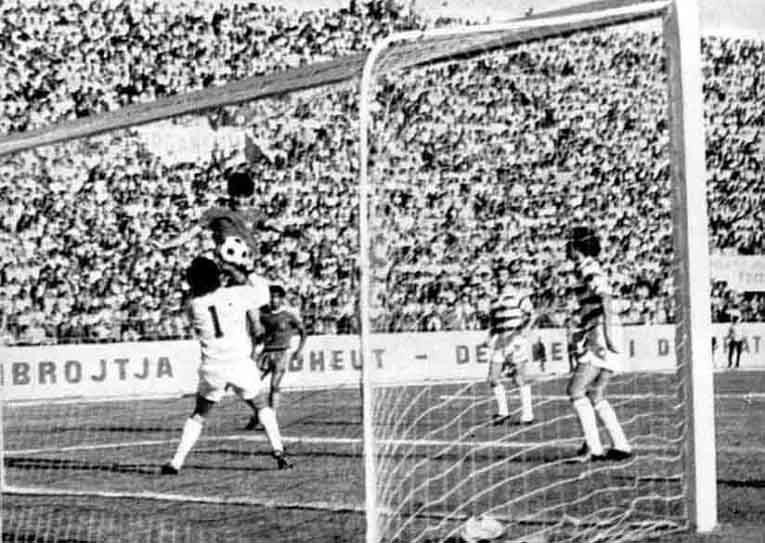
Known across the stadiums of the nation as the undisputed “Mbreti i Ajrit” (The King of the Air), Murati did not merely contest crosses in the penalty box—he weaponized them. To witness Murati at the peak of his physical powers was to observe a masterclass in athletic poetry: a footballer who could read the trajectory of a leather ball, explode off the turf, hang suspended in mid-air as if gravity had momentarily lost its grip, and strike with a devastating, clinical header that left defenders frozen and goalkeepers clutching at shadows.
Over 75% of his magnificent career goal haul was scored entirely with his head, a statistical anomaly that terrified the backlines of the country for over a decade. This unstoppable flight was not a localized phenomenon; it was an elite standard of performance that could be testified to by the finest shot-stoppers in Europe, from the bruised and beaten domestic custodians to the Scottish international goalkeeper of the European heavyweights, “Celtic” Glasgow.
This is a entirely original narrative structure—a tribute to the grit, the mystery, and the immortal legacy of the legendary number 10, formulated with pure, objective facts for the definitive sports archive.
The Scouting Report: Loro Boriçi’s Discovery
The architectural foundation of Agim Murati’s legendary career was built on March 8, 1953, born in the town of Shijak. Emerging as the fourth son of a highly recognized local footballing dynasty, his structured development opened inside the youth ranks of his hometown club, “Erzeni” Shijak, in 1967. By 1970, his raw physical intuition inside the penalty box forced the senior technical staff to place the 17-year-old directly into the top-flight first-team line-up, where he immediately asserted himself as an immovable fixture.
The definitive structural crossroads of his sporting life materialized later that year during a high-stakes friendly exhibition between “Erzeni” and the capital’s developmental academy side, “Shkëndija” Tiranë. Watching closely from the grandstands was the legendary mastermind manager, Loro Boriçi. During a crucial attacking play, the lean, lanky Shijak teenager rose above a dense cluster of mature defenders, meeting a cross with an explosive header that rattled the back of the net. Boriçi, possessing an unmatched eye for elite physical parameters, immediately reached for his notebook, recorded the teenager’s physical attributes, and returned to the capital with an absolute institutional command to extract the prospect from Shijak and bring him directly to the Reds.
The Rebel in the Sport Suit: Defying the Ministry Machine
Upon his arrival at the legendary club headquarters of “Partizani”, Murati was met with an immediate, rigid institutional conflict. The Ministry of Defense aimed to leverage its structural authority to enlist the rookie directly into the strict military high school, “Skënderbej”, to complete his academic studies under army discipline.
Murati, displaying an early flash of the uncompromising defiance that would later characterize his play on the pitch, flatly refused the administrative assignment, demanding instead to finish his education at a regular civilian high school as previously discussed with Boriçi.
The administrative tension escalated the following morning when a military officer arrived in a staff vehicle to transport the rookie to the academy. Refusing to step inside the car, Murati slung his sports bag over his shoulder, walked completely out of the complex, and fled the capital on foot to return to his family home in Shijak.
Upon discovering the bureaucratic breakdown and noting his top prospect’s absence from the afternoon training block, Boriçi bypassed the military channels entirely. He ordered the club car to be dispatched to Shijak, sending the iconic striker Refik Resmja to personally secure the player’s return under a binding club guarantee that he would be enrolled in the civilian gymnasium, “Qemal Stafa”.
The Baptism of Fire and the Gerd Müller Parallel
By October 1971, following three months of grueling, high-intensity training alongside the country’s ultimate icons, Murati’s formal integration materialized on the pitch. During the second half of a tense match against “Shkëndija” at the “Dinamo” Stadium, Boriçi signaled to the bench and ordered the skinny teenager into the match without a formal warm-up, tasking him with replacing Neptun Bajko.
Standing at just 1.78 meters and weighing less than 65 kilograms, the rookie initially struggled with the physical scale of the arena, losing his footing on his opening touch.
The tactical gridlock dissolved seconds later through the direct intervention of the great Panajot Pano, who positioned himself closely alongside the rookie to settle his nerves, urging him to shake off the pressure and remain close on the attack. Within two minutes of the substitution, Pano whipped a half-high cross from the left wing. Murati exploded horizontally, throwing his body forward in a breathtaking, textbook diving header (plonzhon). The strike beat the keeper cleanly, rattled the base of the post, and ricocheted away.
Pano immediately celebrated the brilliant effort, noting that a mere two centimeters separated the young striker from mirroring the instant legendary history of Germany’s Gerd Müller, announcing the arrival of a special aerial technician to the national game.
The Masterclass: 27 Minutes of Capital Destruction
Murati quickly transformed from a lean prospect into a clinical, goal-scoring machine, shattering a six-year monopoly held by “Dinamo”‘s legendary forward Ilir Përnaska to assert his own dominance over the league.
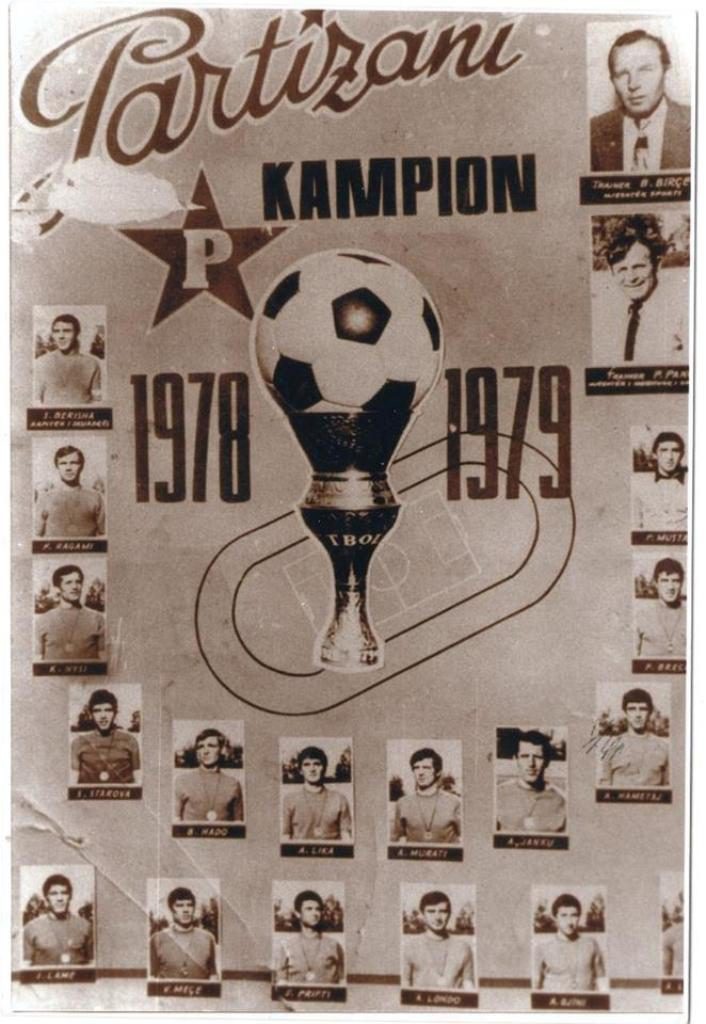
He captured three consecutive Golden Boot titles as the top goalscorer of the National Championship:
1976–1977: 12 Goals
1977–1978: 14 Goals (Securing the National Championship Title)
1978–1979: 14 Goals
Yet, his absolute masterpiece was carved into the history books on December 28, 1980, during the fierce, high-stakes capital super-derby against “17 Nëntori” (Tirana) in front of a capacity crowd of over 15,000 fanatical spectators. Murati had an historic relationship with the derby, scoring 11 goals in 9 matches against the arch-rivals, but this winter afternoon bordered on the supernatural.
Within a frantic, breathless window of just 27 minutes, Murati tore the “17 Nëntori” defensive grid to shreds.
He struck three times, executing an unmatched hat-trick where every single goal was delivered entirely with his head, dragging “Partizani” to a legendary 3–2 victory. To this day, he remains the only player in the history of the Army club to score a hat-trick in the capital derby against Tirana.
Another iconic testament to his commitment occurred on May 16, 1976. Until 2:00 PM that afternoon, Murati was in Shkoder celebrating his own engagement. Having given his solemn word to Boriçi that he would not abandon the team, he checked his watch, left his own engagement party, traveled to the capital, and walked into the locker room at 4:00 PM. He stepped onto the grass against “17 Nëntori” and smashed two brilliant goals to orchestrate a 3–2 triumph.
The European Target: Stunning the Celtic Giants.
On September 19, 1979, international football returned to the capital as “Partizani” hosted the Scottish champions, “Celtic” Glasgow, in the first leg of the European Cup after a multi-year continental absence.
Under the electric floodlights of a packed stadium, Murati produced an unforgettable display of his trademark aerial dominance. Navigating the heavy, physical marking of the towering Scottish international defenders, Murati read a flighted cross, leapt above the Celtic backline, and powered a magnificent header past the visiting goalkeeper to secure a famous 1–0 victory for the Albanians.

The Sacred Inheritance: The Day Pano Surrendered the Number 10
The most poignant and enduring chapter of Murati’s career occurred on May 25, 1975, a day that left an entire stadium weeping. It was the official retirement match of the undisputed king of Albanian football, Panajot Pano. The grandstands were packed to absolute maximum capacity, generating an atmosphere normally reserved for a clash against West Germany or Italy.
Before the opening whistle, a magnificent, unannounced ceremony commenced. Pano walked to the center circle, removed his iconic jersey, kissed it, and personally draped the heavy, sacred Number 10 shirt over the shoulders of Agim Murati. The stadium erupted into a thunderous, unanimous ovation. The fans understood the weight of the gesture: the past was passing the torch to the future. For the next decade, the history of “Partizani” would recognize only two standard-bearers of that heavy number: Pano and Murati.
The Secret of 29: The Unsolved Enigma
In 1983, at the absolute zenith of his physical powers and technical prime, Agim Murati shocked the nation by walking away from football completely at just 29 years old. He had scored over 120 goals in 12 seasons for “Partizani”, won two league titles, and captured two Republic Cups. He held the all-time club record for goals in a single match—hitting 5 past “Besa” Kavaja in 1974 (a European-level single-game record that went unmatched for 20 years until a Hungarian striker equaled it in the mid-1990s).
Yet, a deep, irreparable fracture had occurred between the player and the military club’s hierarchy. The seed of discontent had been planted during a European campaign against “Austria Wien”, when the head coach punitively left Murati sitting on the bench. As his teammates fought on the grass, Murati suffered in silence on the bench, an agonizing sporting heartbreak he never forgot.
Years later, during an intimate conversation with a lifelong journalist friend, the forward was pressed to reveal the deep-seated motivations behind his premature exit. Rather than opening old wounds or pointing fingers at the institutional leadership, Murati chose to protect the integrity of his legacy, categorizing his departure strictly under objective reasons that were no longer worth debating.
He maintained that walking away at twenty-nine allowed him to leave his elite reputation pristine in the hearts of the sports public, ensuring he would forever be remembered at the absolute absolute peak of his footballing powers, leaving the deep enigma of his final fracture completely unsolved.
Following his retirement, Murati earned a degree in sociology from the Faculty of History and Philology in 1977 and served as a highly respected military officer within the Ministry of Defense structure. On December 27, 2009, he was posthumously honored with the prestigious title “Legjenda e Futbollit Shqiptar” (Legend of Albanian Football) and awarded the Silver Order of Naim Frashëri, alongside his title as a Merited Master of Sport.
In mid-July 2005, during a sweltering morning in Tirana, old friends crossed paths near the Artistic Lyceum. Spotting Murati riding a simple bicycle with his pink sweater soaked in sweat while heading to a football federation meeting, his colleagues jokingly teased him about leaving his luxury Mercedes Benz in the shade of his apartment block.
Murati simply laughed off the banter, revealing with typical humility that the modest two-wheeler had functioned faithfully as his personal luxury vehicle for twelve straight years since a previous model had been stolen from him.
It was the final meeting. Exactly two months later, on September 15, 2005, Agim Murati passed away suddenly after a brutal, rapid battle with acute leukemia. He was only 52 years old.
While the administrative files record only 3 official international caps for “Kombëtarja” between 1973 and 1976 due to the nation’s total international isolation, his true footprint spans over 50 international club appearances and friendly matches, particularly against Chinese touring sides. He remains the ultimate emblem of Shijak sports heritage, an un-compromised icon who proved that a striker’s true dominion is not found on the grass, but ruled from the open skies.
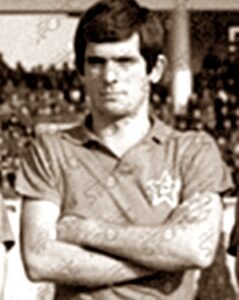 International Appearance Log: “Kombëtarja” Archive
The official, verified international database records the following competitive parameters for Agim Murati’s senior national caps:
Year Competition / Fixture Status Goals
1973 World Cup Qualifying: Albania 1–0 Finland (Oct 10) Substitute (Phase II Entry)
1973 World Cup Qualifying: Albania 1–4 East Germany (Nov 3) Starting Line-up
1976 International Exhibition: Albania 3–0 Algeria (Aug 31)
Starting Line-up
Total 3 Senior A-Caps 2 Starts / 1 Sub
© By Pjerin Bj
Bronx: August 2, 2026
________________________________
Sports Vision + Plus in activity since 2013

Discover more from Sports Vision +
Subscribe to get the latest posts sent to your email.


