
The Bettors and Fixed Results in Albanian Football!

Prologue!
On one hand, the slogans, red flags, portraits of the communist leader, and official propaganda presented a world closed off to the West.
On the other hand, within that very same society, people gathered secretly or semi-openly to discuss Italian Serie A football, the Yugoslav championship, American boxing, Mike Tyson’s fights, or world athletics—like the famous 100-meter duel between Ben Johnson and Carl Lewis.
They placed bets on basketball games, from Dražen Petrović’s famous ‘Cibona’ to Mike D’Antoni – Dino Meneghin`s ‘Tracer’ Milano… and the betting extended even to a Boris Becker tennis match or music discussions on who would win the ‘Sanremo’ Festival.
This is where the paradox lies, captured so beautifully: in these photos, although artificially created, official propaganda had a world of its own, while people’s daily lives had another. People may have lived within the system’s restrictions, but their interests, curiosity, passions, and ways of engaging with the world did not always align with what was officially preached.
And yet, a small distinction should be made: not everyone who placed bets was consciously opposing the regime. Some were simply seeking the thrill of the match, making a bit of money, or enjoying the pleasure of prediction. But regardless of their intentions, this scene reveals an extraordinary contrast between the official image and the real habits of the people.
Betting is always been a trouble phenomenon in the world of sports.
Betting and suspicions surrounding fixed results have been, and remain, a troubling phenomenon in the world of sport, particularly in football.
At various times, this phenomenon has involved athletes and sportsmen themselves, management staff, supporters, and even the highest-ranking officials within sports associations and institutions.
In some cases, the networks behind this corruption have proved deep-rooted and long-lasting, forcing judicial authorities to launch investigations and impose penalties ranging from fines to prison sentences.
Nevertheless, despite investigations and severe sanctions, betting and match-fixing have continued to exist to this day, primarily in international sport. Over time, the phenomenon has become increasingly sophisticated in its organisation, even as many countries have established monitoring systems and specialised institutions to combat it.
In the past, during Albania’s communist era and the socialist period, the weekly newspaper “Sporti Popullor”, the country’s only regular sports publication of its kind, occasionally devoted space, particularly on its back page, to corruption scandals in international sport. Events from neighbouring Italy also attracted attention, where the Totocalcio betting system had become embroiled in several high-profile cases.
One of them was the 1980 scandal involving businessmen Crucciani and Trinca. They reported a considerable number of footballers to the judicial authorities, including well-known members of the Italian national team, such as Enrico Albertosi, the goalkeeper of the 1970s; the outstanding striker and goalscorer Paolo Rossi; Bruno Giordano; and others associated with the clubs “Milan”, “Lazio” and “Perugia”. Bets worth millions of lire were placed, while it was suspected that match results were being determined through agreements among those involved, who sought to make substantial amounts of money for themselves, the footballers and their associates.
Italian football cannot be discussed without mentioning the 2006 scandal, which involved the club “Juventus” and its executives Moggi, Giraudo and Bettega.
For some time, “Juventus” had been embroiled in a serious affair that would shake Italian football. Eventually, the scandal erupted!
The accusations were based on material and evidence linking the suspected network of influence over match results to Serie A referees.
According to the allegations, referees were placed under pressure and could face consequences if they refused to comply with the demands of “Juventus” executives. The club was relegated to Serie B, while legal proceedings and debates over the responsibility of those involved continued afterwards.
Naturally, there is no need to dwell on the endless labyrinth of this phenomenon or list the many incidents that have occurred around the world.
The well-known journalist and commentator Skifter Këllici, in his book “The History of Football”, sums up this reality with an expression that we borrow here:
“A comedy in which business directs, plays and scores goals.”
Exactly!
But what about Albania before the 1990s?
In Albania during that period, football and sport in general were presented as fields free from scandals and from what were regarded as manifestations of “bourgeois-revisionist” professionalism.
But was that really the case?

Quite the contrary. Even in Albania before the 1990s, despite strict state control, harsh laws and the absence of a specialised system to combat this phenomenon, suspicions and allegations existed concerning various forms of influence over sporting results. Nevertheless, the scale of the phenomenon cannot be compared with the major scandals that have shaken international football.
In this case, too, the influence may have been more limited, but its consequences, wherever it existed, were not necessarily insignificant.
During the 1950s and 1960s, although the available hypotheses and information are unclear and not always supported by written documentation or official accusations, there were rumours of smaller teams from the districts surrendering results. According to these accounts, the pressure came from senior party and military officials, with the aim of ensuring that nothing stood in the way of the two teams that consistently competed for the championship title: “Partizani” and “Dinamo”.
Another issue that emerges in discussions about the history of the championships of that period concerns the use of a goals coefficient to determine the champion when two teams finished level on points. According to historical figures cited in this debate, this method of calculation favoured “Dinamo” on more than one occasion.
Specifically, at the end of the 1950 championship, “Dinamo” and “Partizani” finished the season level on points. “Dinamo” scored 60 goals and conceded six, while “Partizani” scored 77 and conceded ten.
Both teams recorded 16 matches played, 14 wins, one draw and one defeat. According to a later interpretation of these statistics, if goal difference had been applied, “Partizani” would have held a clear advantage: +67 compared with “Dinamo’s” +54. Nevertheless, the title was awarded to “Dinamo” through the application of the goals coefficient, calculated by dividing the number of goals scored by the number of goals conceded.
The same method was used five years later, when “Partizani” and “Dinamo” once again finished level on points. The goal difference was +81 for “Partizani” and +65 for “Dinamo”, yet the title was again awarded to the latter. These decisions have remained part of the historical debate over how the champions were determined in those seasons.
In the years that followed, other cases were also discussed, raising questions about the fairness of the championships.
One such case concerns the 1964–1965 season, when “17 Nëntori” managed to break the dominance of “Partizani” and “Dinamo”. According to criticism of the fixture schedule during that period, the Tirana side was given the opportunity to play three outstanding matches during the final three weeks of the championship, while its title rivals, “Partizani” and “Dinamo”, had already completed all their fixtures.
The name of “Vllaznia” has also featured in several historical controversies. These discussions concern Republic Cup finals against “Besa”, as well as the championship title in the 1982–1983 season, when “Partizani” drew 1–1 away to “Besa” in Kavajë. Some later accounts have alleged that the result was influenced by outside intervention. However, such a claim requires documentary evidence to substantiate it.
Among the teams that, according to contemporary discussions and later accounts, felt disadvantaged by decisions or disputed results involving the four leading sides—“Partizani”, “Dinamo”, “17 Nëntori” and “Vllaznia”—were “Flamurtari” during the 1980s, “Skënderbeu” in the 1976–1977 season and “Luftëtari” in the 1977–1978 season.
In particular, allegations have circulated concerning “Flamurtari” in the 1985–1986 season and gifts consisting of bags containing sports uniforms that, according to these accounts, “Dinamo” had given to “Luftëtari”. This allegation, like other similar cases, must be assessed in light of whatever documentation can be found to support it.
Nor should the great “Besa” side of the 1970s be overlooked, along with the teams fighting to remain in the First Division: “Naftëtari”, “Traktori”, “Tomori” and “Besëlidhja”. Particularly during the 1980s, the home grounds of these teams were sometimes described as difficult places for the bigger sides to visit. At the same time, in the final weeks of the championships, suspicions circulated about results that might have benefited or harmed teams competing for the title or fighting to avoid relegation.
Was this the result of shortcomings in the organisation of the Albanian Football Federation (FSHF), the rules applied in the championship, or occasional interventions by influential individuals who, it was alleged, also acted out of loyalty to particular teams?
The question cannot be answered with certainty without sufficient documents and evidence.
One conclusion that should be avoided is the one frequently repeated in certain journalistic accounts: that some teams were favoured by the regime while others were persecuted. Such a simplified portrayal does not necessarily explain the complexity of football during that period, particularly given that the political and administrative system exercised extensive control over life in the country, including sport.
Despite the alleged irregularities surrounding the championships, stadiums throughout Albania were filled with supporters, while football consolidated its position as the public’s most beloved sport.


None of this diminishes the achievements of the champions representing Albania’s finest football teams or those of the outstanding footballers they produced: the stars of “Partizani” and “Dinamo”, as well as those of “17 Nëntori”, “Vllaznia”, “Flamurtari”, “Besa”, “Labinoti”, “Luftëtari” and “Lokomotiva”.
Ultimately, this was, in broad terms, the picture of suspicions surrounding corruption and the buying and selling of results in Albanian football during that period.
The Bettors!
During the 1980s, in several Albanian cities, particularly Tirana and Shkodër, there were distinct groups of supporters who gathered every Sunday before the week’s matches to place bets and organise betting slips.
This activity took place openly. Predictions for match results were written on pieces of paper and long strips, in a format resembling a kind of sports lottery.
The predictions were not limited to the Albanian championship. In Shkodër, for example, people also discussed and predicted the week’s matches in Italy’s Serie A, the Yugoslav championship, football and basketball fixtures, and European cup competitions.
Interest extended beyond football. In athletics, major contests such as those between Ben Johnson and Carl Lewis attracted attention, while in boxing, Mike Tyson’s fights were followed with particular interest—not only when his victory was predicted, but also when someone dared to bet against him.

In Shkodër, well-known locations such as the main boulevard, “Pjaca”, “1 Maj” Garden, “Kafja e Madhe”, the pavement beside the “Rozafat” tourist hotel, the garden opposite the fire station and the area behind the old bust of the “5 Heroes” filled with people, especially during European and World Championships.
According to the recollections of those who experienced that period, these gatherings also took place in the presence of police and security forces, who stood nearby, although they did not always intervene.
For the generation now aged between 50 and 70, this is part of the collective memory of the 1980s, both before and after the death of communist leader Enver Hoxha. For many of them, these scenes are personal testimony to a reality that existed alongside the system’s strict rules and the official image of a sporting world supposedly free from such practices.
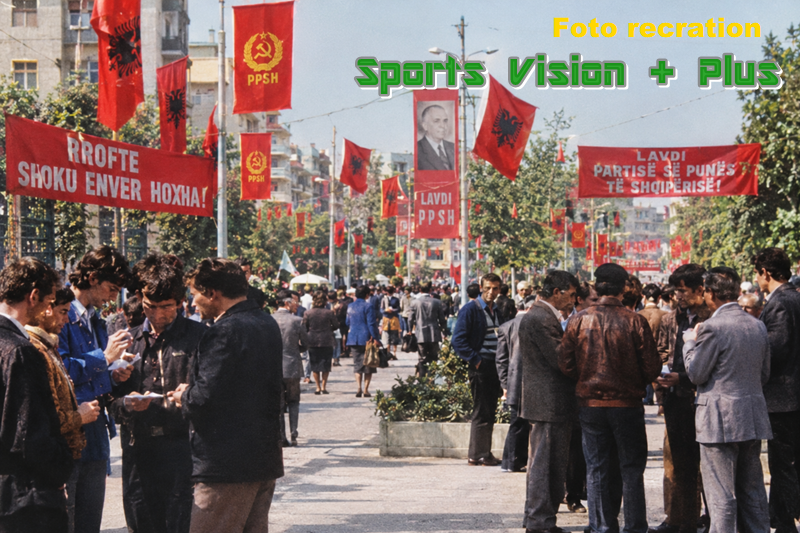
“Yes! Bets were being placed.”
According to accounts from the time, considerable sums of money also changed hands, while certain individuals became recognised names in this activity, which might be described as a kind of Shkodër version of “Totocalcio”.
Among the names mentioned in these recollections are: Ceka, “Bushi – Flokëteritali”, “Kapertoni”, “Brisku Rrues”, “Miu”, “Bergomi”, “Kaçi”, “Manoli”, “Gufi”, “Gami”, “Piti” and “Dhici”….and so on!
 This activity began to expand and grow significantly, particularly during the second half of the 1980s. According to some accounts, on certain occasions it may even have influenced the conduct of matches in Albania, owing to direct or indirect connections between individuals involved in betting and footballers. In this context, movements and contacts between Shkodër and Tirana are also mentioned.
Without wishing to diminish anyone’s achievements, it must be acknowledged that several unexpected victories and heavy defeats have, over the years, remained under a cloud of suspicion surrounding the surrender or sale of results. According to some allegations, these suspicions were linked to the influence of particular groups of supporters.
The high-profile defeats suffered by “Partizani” in Tirana during the 1980s—0–3 against “Naftëtari”, 2–5 against “Luftëtari” and 3–7 against “17 Nëntori”—have occasionally been cited as examples that prompted suspicions of possible influence over results by certain groups or individuals among the supporters.
It is well known that the Laprakë area of Tirana has historically been one of the important strongholds of “Partizani” supporters. Their backing was passionate, but accounts from the time also raised suspicions of direct or indirect links between some supporters and the team, as well as possible influence over particular results, especially towards the end of the 1980s.
Naturally, in the absence of official documentation proving these allegations, they remain hypotheses and rumours of suspicion that circulated at the time. This was the period of the dictatorship of the proletariat, when sport was officially portrayed as being free from the practices associated with “bourgeois-revisionist” sport.
Surprises are part of football’s beauty. A smaller team can defeat a champion, a favourite can lose, and an unexpected result can remain in the memories of supporters for years. But it is equally important to distinguish a sporting upset from a result that may have been influenced by secret agreements between footballers or officials seeking to make money.
Nevertheless, as long as official investigations and documents proving the surrender or sale of results are lacking, these suspicions remain unproven. Over time, many have disappeared into a fog of uncertainty, leaving room for interpretations and theories that are difficult to verify.
But could anyone really have imagined an investigative team being organised and the facts about suspected cases of surrendered or sold matches being made public in socialist Albania?
Even those who experienced that period firsthand can testify to what they saw and heard. Yet personal testimony, however important, cannot always replace documentary evidence. Thus, even if there is a conviction that cases of corruption and influence over results existed in Albanian sport at the time, the full truth about many of these events may remain unknown.
Following the collapse of the regime, sports betting took on a different form and developed through dedicated betting centres, becoming part of an organised market. However, the formalisation of this activity did not put an end to suspicions of match-fixing and manipulated championship titles. The way betting was organised changed, but questions about the integrity of competition continued to arise.
During the first decade of the new century, Albania went through a difficult period of transition following the change in its political system. In this climate, the debate over the history of Albanian football took another direction. Allegations increased that certain teams, regarded as having been persecuted in the past, had lost titles in favour of teams associated with the previous system.
In the author’s view, some of these interpretations, presented by a section of the sports media, have gone so far as to call for the rewriting of the histories of “Partizani” and “Dinamo”, portraying these clubs as unjust beneficiaries of championship titles.
This debate also refers to well-known footballers from “Partizani”, including Boriçi, Pano, Bizi and R. Rragami, as well as players from “Dinamo”, such as Jareci, Gjinali, Zëri, Përnaska and Sh. Ballgjini. From the author’s perspective, the histories of these clubs and their footballers should not be devalued through later interpretations that are not supported by sufficient evidence.
Another issue raised in this debate concerns how football competitions held before the Second World War have been assessed. The author opposes attempts to revise the status of certain tournaments from that period, arguing that the organisational conditions, logistics and playing surfaces were very different from those of championships held in subsequent decades. On some grounds, according to his description, even the basic conditions for playing a match were missing, with a rope being used in place of a crossbar.
For the author, this approach to revisiting the past risks creating a history clouded by one-sided interpretations, censorship, selective use of facts and readings coloured by politics.
And so, according to this logic of revising and rewriting history, future generations may be confronted with a picture similar to the one we encounter today: a history in which the roles of protagonists and antagonists change whenever the prevailing perspective changes.
“Willingly or unwillingly, only in Albania does history repeat itself by turning the protagonists of one regime into the antagonists of the regime that follows.”
A kind of historical revenge, in which one side takes its turn against the other.
But could this not also be considered another form of historical distortion, when particular interpretations are formulated, repeated and documented without always being based on a thorough examination of the facts?
Is this not, too, a phenomenon that deserves to be investigated with the same degree of seriousness?
© Copyright is of Piero SVP
Hudson Yard, New York City: August – October 2026
Note: The photos are recreation, people in these photos are factious and replaced on original pictures of Shkoder City in the 80-ties.
____________________________
Sports Vision +Plus since 2013

Discover more from Sports Vision +
Subscribe to get the latest posts sent to your email.


