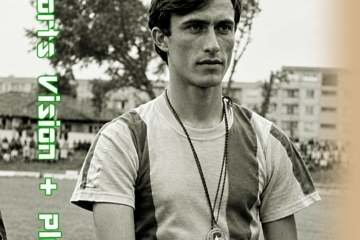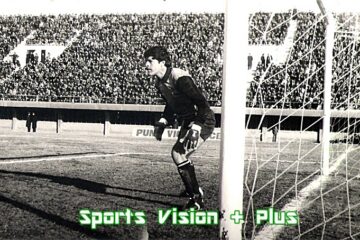
Aleksandër Kondo (1960–1987): From the Great Weightlifting Champion to the Mystery That Still Seeks an Answer: Accident or Assassination?
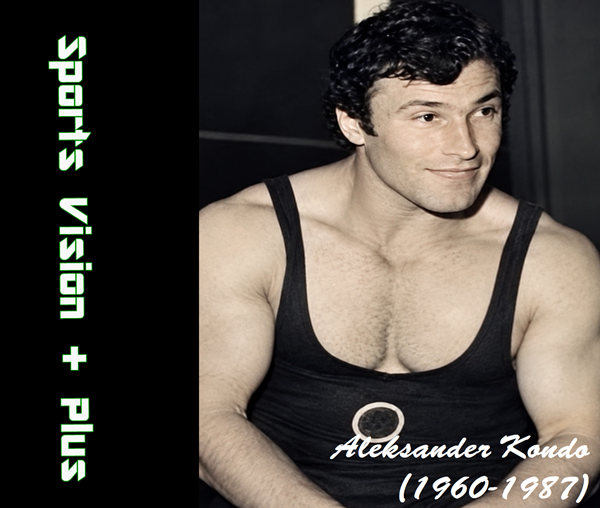
Prolog!
In the history of Albanian weightlifting, the name of Aleksandër Kondo is linked to a generation of athletes who pushed the boundary of what Albania could achieve in the international arena.
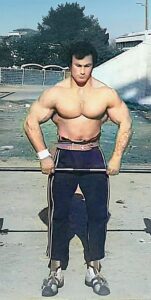
Kondo was one of the most prominent figures of this generation, an athlete from Fier city who gradually rose to the top, set national records, and managed to confront weights that for many years seemed unachievable for the Albanian barbell.
But his story does not end on the competition platform. In 1985, after the European Weightlifting Championship in Katowice, he never returned to Albania. The escape to the West would change his life forever and would eventually lead him to the United States of America, where he started another chapter, far from the sport that had made him famous. Only two years later, in New York, his life was cut short under circumstances that even today raise questions.
American documents record the death as a consequence of an automobile accident, while documents from the former State Security (Sigurimi i Shtetit), testimonies gathered after his death, and other episodes related to the final weeks of his life have fueled suspicions that something more than an accident could be hidden behind the event.
Here begins the story we want to tell: not a story built on conjecture nor a conclusion taken in advance, but an effort to reconstruct the life of a champion, his path from Albania to America, and the circumstances of his death in Queens, separating what the documents show from what remained unclear.
Aleksandër Kondo remains a great name of Albanian weightlifting, but behind him there has also remained a question that, decades later, still seeks an answer supported by evidence: what truly happened to him in New York?
The Great Champion in Albania
From Fier to “Dinamo”, The Journey of Champion Aleksandër Kondo!
Aleksandër Kondo was born in Fier in 1960, but his sporting and professional life would very quickly lead him toward Tirana, where he would build his name as one of the most famous Albanian weightlifters of the ’80s.
In the declassified documents of the State “Sigurimi”, Kondo figures as the son of Vangjel and Antigoni. A document from 1985 describes his family as having a “good political background and standing” and emphasizes that within the family and social circle there were no convicted, escaped, or interned persons.
The father, Vangjeli, was an officer in the structures of the Ministry of Internal Affairs and had served in the Republic’s Guard, while an uncle of Aleksandër was a police chief in Gjirokastër.
This part of the documentation is important to understand a paradox of his history: Kondo did not come from a family that, according to the Albanian “Sigurimi” documents themselves, would be categorized as a family with a “bad biography” or with a known anti-communist past.
On the contrary, the documents of the time presented the family in positive terms from a political point of view. This does not mean that Aleksandër’s relationship with the system was simple. His file shows that he had been surveilled for years and that, gradually, his behavior, lifestyle, contacts with foreigners, and his stances outside Albania became an object of interest for the State Security.
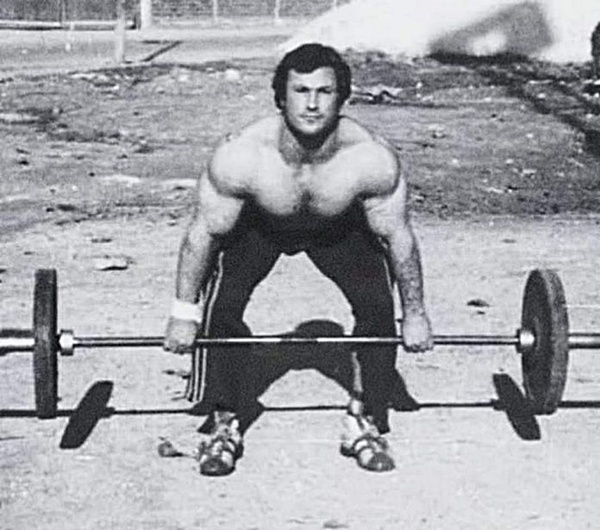
His path toward sport started after completing eight-year education. In the beginning, he worked as an apprentice mechanic at the Agricultural Tools Plant, while simultaneously starting to engage in weightlifting. He performed his military service at the “Dinamo” Sports Club, where he also consolidated himself as a weightlifter. A biographical document from 1984 already describes him as a national champion and directly links his sporting rise to the “Dinamo” period.
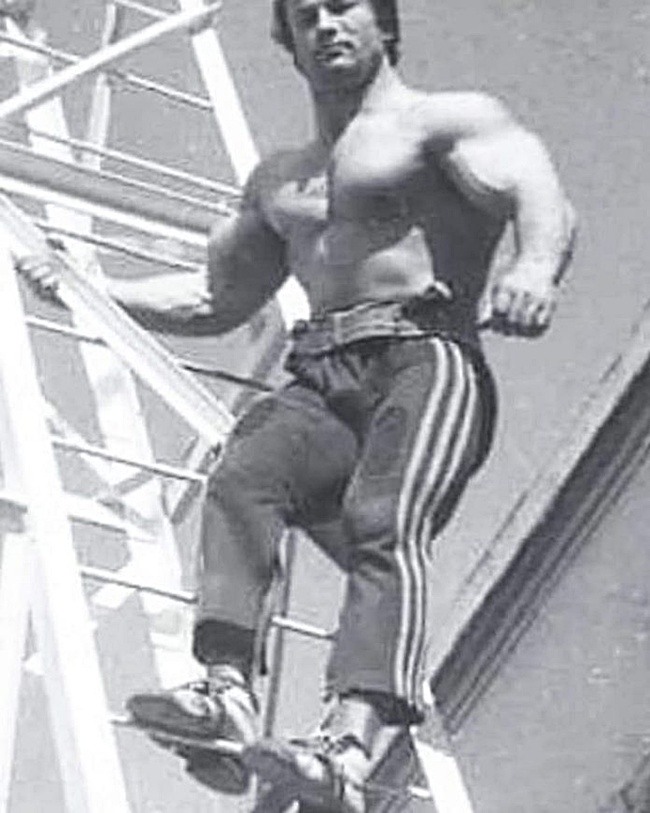
In the early years of his career, Kondo began to appear not simply as an athlete with potential, but as a weightlifter who was pushing national records to new levels.
In 1981, he improved the Albanian record in the snatch discipline, from 127.5 to 132.5 kilograms. A year later, in the 82.5 kilogram category, he was declared national champion. In March 1983, at the Republic Cup in Korçë, he pushed the record in the clean and jerk discipline from 163 to 180 kilograms, while in an international meeting in Turkey, in May of that same year, he won first place and improved the national record again.
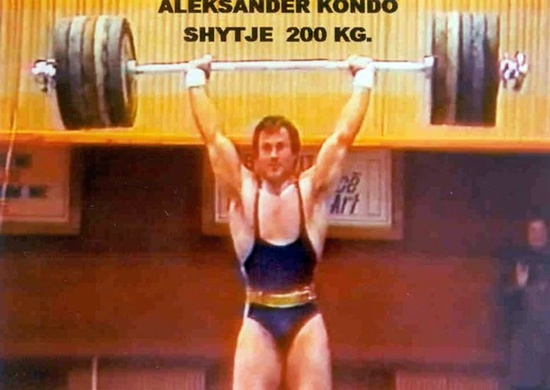
But the big explosion would come in 1984. In the Republic Cup, at the “Asllan Rusi” Sports Palace, Kondo competed in the 90 kilogram category and achieved 200 kilograms in the clean and jerk discipline.
Sources that have reconstructed his career describe this as the first time such a weight was lifted in the history of Albanian weightlifting.
It was the moment when the name Aleksandër Kondo crossed from championship results and sporting records into another dimension. He became a well-known figure in Tirana and in all of Albania.

The memory of that day, according to testimonies published later, is linked to a packed Sports Palace and to sports fans who continued to stand outside, waiting to see from up close the champion who had just entered a new territory of Albanian weightlifting.
In this period, Kondo was part of “Dinamo” and the national team. The Security documents show that he had gone outside of Albania several times with the Albanian representative team, Romania, Yugoslavia, Turkey, Algeria, Greece, Spain, and, finally, Poland, and that by 1985 he was already an internationally recognized athlete.
In the materials we have checked so far, his participations in international activities, such as the Balkan
Championship in Romania, the meeting in Turkey, and the European Championship of 1985, are clearly found, but we have not found a sufficiently reliable source that would allow us to declare that Kondo participated in a senior World Championship before his escape.
By the spring of 1985, his career had entered its highest phase.
In the European Weightlifting Championship in Katowice, held from May 22 to May 26, Kondo was part of the Albanian national team.
According to sports sources published later, he achieved third place, while in training he lifted 210 kilograms in the clean and jerk discipline.
But Katowice would not be remembered only for the sporting result. For Aleksandër Kondo, those days would be the end of the life he had known until then in Albania.
On May 28, 1985, during the return of the Albanian delegation through Yugoslavia, Kondo and the Shkodra weightlifter Xhelal Sukniqi detached themselves from the group in Titograd and requested political asylum.
The “Sigurimi” documents clearly record the moment: the two athletes never returned with the team and presented themselves to the United Nations structures for refugees.
Thus closed the Albanian chapter of Aleksandër Kondo.
But, without anyone knowing then what the coming years would bring, the escape from Titograd was not the end of the champion’s story.
It was only the beginning of its darkest part.
The link beside for the first article: https://www.sportsvisionplus.com/the-weightlifter-champion-aleksander-kondo/
The Day the Champion never returned back to Albania!
The European Weightlifting Championship in Poland had concluded.
The Albanian delegation started the return journey. The route passed through Yugoslavia. In Titograd, near the border with Albania, Aleksandër Kondo and Xhelal Sukniqi, the weightlifter of “Vllaznia”, detached themselves from the group.
They never returned to Albania. They requested political asylum. The escape was so sensational that the Albanian authorities began to treat it as a matter much larger than an ordinary escape.
Kondo was already outside the country. But his history with Albania had not ended.
On the contrary.
According to the Albanian State “Sigurimi” documents, the surveillance against him continued even after the escape.
America — A new life, but not a forgotten history
In the United States, Kondo settled in New York, within the Albanian community of Queens.
Testimonies published later describe him as an active figure in the Albanian community and in activities against the Albanian communist regime. An interview published years later describes his participation in demonstrations against the regime in New York shortly before his death.
Kondo, always proceeding according to sources, was no longer simply a former Albanian weightlifter. He became a political emigrant, from a well-known athlete who had left Albania.
Meanwhile, in Tirana, his file continued to be followed.
And then something happened that even today remains one of the most important elements of the mystery.
20 March 1987 — The First Accident!
About a month and a half before his death, Aleksandër Kondo suffered an accident.
A “Sigurimi” report dated April 4, 1987, states that on March 20 he had been crashed into by an unidentified person.
According to the report, Kondo had suffered fractures in three ribs and in his neck and had stayed three days in the hospital.
But there is a much more important detail.
According to the same material, Kondo had expressed suspicion that someone was trying to kill him.
The report states that an unidentified person had cut in front of him with a car on the highway and then sped away.
There is no court decision that determines this as an assassination attempt.
There is also no identification of the person.
But there is a document recording that Kondo himself had suspected an attempt against him.
And just a few weeks later…
30 April 1987 — The Night When Everything Ended!
Queens. Midland Parkway and Croydon Avenue.
A car.
A crash into a fixed object.
And a champion only 27 years old.
A copy of the death certificate published online documents that Kondo was taken to Jamaica Hospital and that the death occurred on May 1, 1987, at 10:15 in the morning.
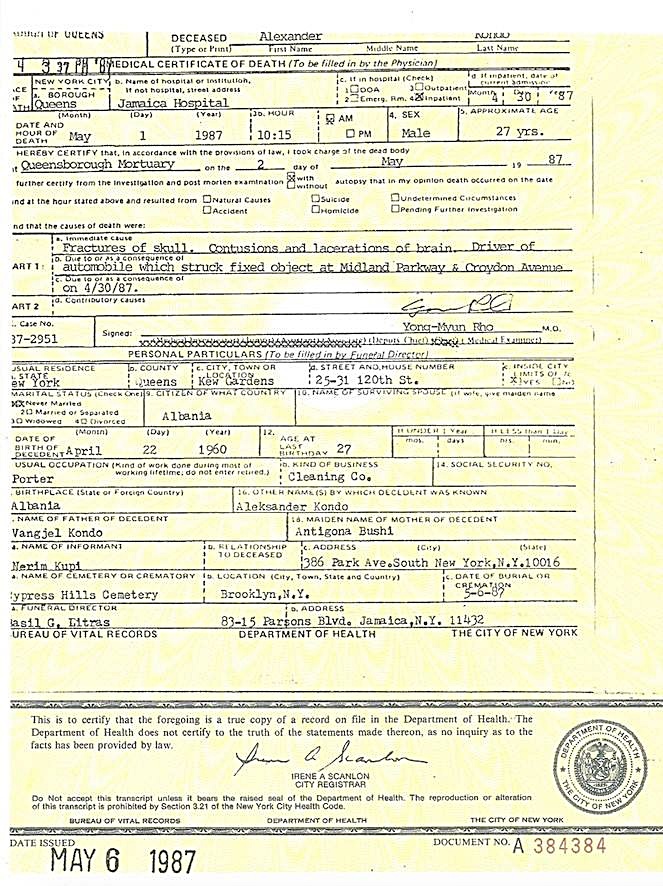
The document mentions the autopsy and as cause the severe injuries to the skull and brain caused when the vehicle hit a fixed object at the intersection of Midland Parkway–Croydon Avenue on April 30.
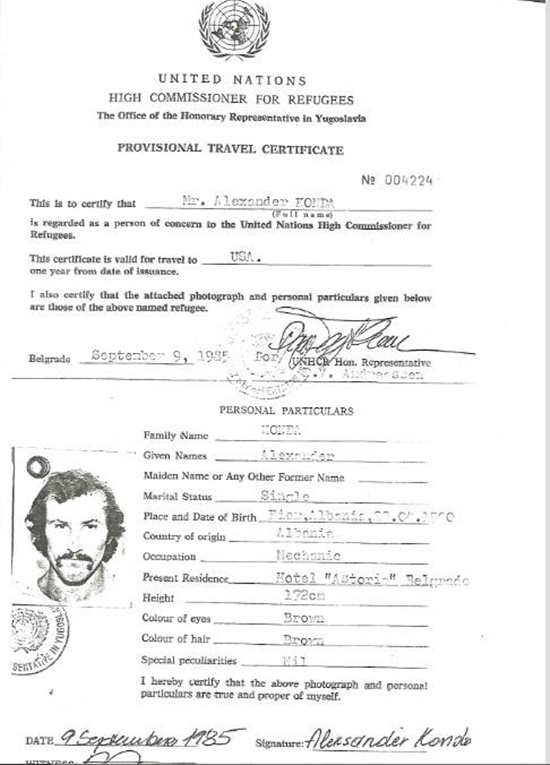
So, there is an American medical document that directly links the death to the automobile accident.
This is the strongest point on the side of the accident version.
But the story does not end here.
The Suspicions — What Happened After the Crash?
In the documents published later from the “Sigurimi” file, another element is found.
A report dated May 15, 1987 claims that two persons had pulled Kondo out of the car and transported him to a hospital very far from the accident scene. The report links this movement to the worsening of his condition and to the hemorrhage that brought his death.
Here we must pause.
Because this is a claim recorded in a Albanian State “Sigurimi” report, not a conclusion of an American investigation that we have verified.
And this is precisely the reason why our article cannot say:
“Kondo was killed.”
It would be a conclusion beyond the evidence we have.
But of course this article can say:
Documents and subsequent testimonies have raised questions that still seek answers.
What Was Said in Albania?
In the days following his death, the news was also recorded in the materials of the Albanian state apparatus.
A bulletin dated May 3, 1987, summarizing the reporting of the “Voice of America”, gives Kondo’s death as a consequence of an automobile accident in New York.
So, the initial version reported was clear:
Accident.
But after the burial and within the Albanian community in New York, accusations also emerged.
A “Sigurimi” relation, published later, records that during the burial ceremony a person from the Albanian community openly accused the Albanian Security for Kondo’s death.
The accusation existed.
But the existence of the accusation is not the same as its proof.
Accident or Assassination?
Now we have arrived at the question that gave the title to this story.
What do we know?
We know that Aleksandër Kondo died in Queens in 1987, at the age of 27.
We know that the American death document links the death to the injuries caused by a vehicle hitting a fixed object.
We know that about a month earlier he had suffered another severe accident.
We know that, according to the “Sigurimi” report, Kondo had expressed suspicion that the March accident could have been an attempt to kill him.
We know that he was under Albanian “Sigurimi” surveillance for years and that his file continued to be followed even after his escape.
We know that after his death there were accusations in the Albanian community that he might have been killed.
What do we not know?
We have not found a verified New York Police document determining that the death was a homicide.
We have not found a court decision classifying the event as an assassination attempt.
We do not have direct proof linking the State Sigurimi to the fatal accident.
And for that reason, we cannot declare the assassination attempt as a fact.
A Mystery That Must Not Be Solved by Conjecture!
Perhaps precisely here lies the weight of this story.
Because Aleksandër Kondo does not need us to invent a final chapter more dramatic than the one he had.
 He was a champion.
He was a record holder.
He was part of the National Team.
He was one of the most famous Albanian athletes of the early ’80s.
In 1984 he had lifted 200 kilograms.
In 1985 he had placed third in Europe.
Then he had made a decision that changed his entire life.
He escaped.
He went to the West.
And at the age of only 27, he died in New York.
If it was an accident, it was an extraordinary tragedy.
If there was something else behind it, the documents we have today are not enough to prove it.
And precisely this is the reason why the question continues to live.
Accident or assassination?
Perhaps the missing documents are still somewhere in an archive.
Perhaps a witness has left behind a memory that has not
been published.
Perhaps the American investigation of that time has an answer that has not yet come to light.
But until then, the story must be told as it is.
With the facts.
With the documents.
With the testimonies.
And with the questions.
Epilogue
The Champion Who Should Not Be Remembered Only for the Way He Died
There is a danger in mystery stories. The mystery can overshadow the man.
And Aleksandër Kondo was much more than the way his life ended.
Before Queens, there was the platform.
Before the accident, there was the barbell.
Before the mystery, there was the champion.
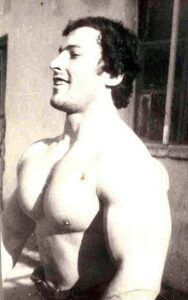
A young boy from Fier who rose to the top of Albanian weightlifting, broke records, lifted 200 kilograms, and became one of the most famous names in Albanian sport in the ’80s.
Then came the escape.
Then America.
Then another life.
And in the end, an intersection of roads in Queens.
A car.
An impact.
A document saying accident.
And a series of questions left behind.
Aleksandër Kondo cannot return.
But his story can return.
And perhaps this is what we owe a champion.
Not to give an answer that we do not have.
But to not allow the question to disappear.
Aleksandër Kondo, from the great weightlifting champion to the mystery that still seeks an answer.
Accident or assassination?
Perhaps history still awaits the final document.
https://www.sportsvisionplus.com/the-weightlifter-champion-aleksander-kondo/
© Copyright by Pjerin Bj
Bronx, New York: September 23, 24, 2026
____________-
Sports Vision +Plus in activity since 2013

Discover more from Sports Vision +
Subscribe to get the latest posts sent to your email.