
“Partizani” of Leipzig 1958 – the silver that entered the history of Albanian football!

Prologue
 Five matches, four victories and a final that did not diminish the greatness of the journey
There are football stories that are not measured solely by the trophy won. There are teams that, even when they do not climb to the highest step of the podium, leave behind a mark that time cannot fade. The Albanian “Partizani” of September 1958 is one of these rare cases in our sporting history.
At a time when Albanian football had few opportunities to regularly face the continent’s major clubs, the red team set off for East Germany to take part in the First Summer Spartakiad of Friendly Armies.
It was an international sporting event that brought together military teams from several countries in Eastern Europe and Asia, many of which were represented by squads made up of high-level footballers.
The tournament featured names that had earned respect in European football.
Among them were “CDNA” of Sofia, “CSKA” of Moscow, “Dukla” of Prague, “CCA” of Bucharest, “Honvéd” of Budapest, “Legia” of Warsaw and “ASK” Vorwärts of Berlin.
These were not ordinary teams assembled by chance for a few friendly matches. Their ranks included highly experienced footballers, many of whom represented or would go on to represent their national teams.
Facing them was “Partizani”, the champions of Albania, with a group of players who would prove that our football could compete beyond its own borders.
The final result of this journey was second place. But the road to the final was much more than a position in the standings. It was a series of victories against strong opponents, a demonstration of collective organisation and proof that Albanian footballers could withstand the pace, intensity and responsibility of international matches.
“Partizani” did not win the cup in Leipzig. But it won something that held particular value during that period: it proved on the pitch that it could stand as an equal against teams representing well-established European football traditions.
The event – the tournament
An international competition with eleven teams
The Spartakiad of Friendly Armies took place in East Germany in September 1958. The event included several sports, while the football tournament was organised in different East German cities and concluded with the final on 28 September in Leipzig.
Eleven teams took part in the football competition:
“Partizani” – Albania
“CDNA” of Sofia – Bulgaria
“CCA” of Bucharest – Romania
“CSKA” of Moscow – Soviet Union
“Dukla” of Prague – Czechoslovakia
“Honvéd” of Budapest – Hungary
“Legia” of Warsaw – Poland
“ASK” Vorwärts of Berlin – East Germany
“Ba Yi” – China
The military representative team of Pyongyang – North Korea
“The Cong” – Democratic Republic of Vietnam
Each represented its country’s military sporting structure. This was an important feature of the tournament: behind the names of the clubs were teams with highly trained footballers, often members of their national elite.
“Partizani” was placed in a group with “CCA” of Bucharest and the military representative team of North Vietnam. The Albanian side finished the group stage in first place, with two victories, six goals scored and only one conceded.
Then came the knockout matches. To reach the final, “Partizani” had to overcome three further obstacles: “Dukla” of Prague, “Vorwärts” of Berlin and, finally, “CDNA” of Sofia.
19 September 1958 – “Partizani”–“The Cong” 5-1
Location: Magdeburg.
“Partizani” began its tournament campaign against the military team of North Vietnam.
At first glance, the 5-1 score might appear to be an ordinary victory. But the way it unfolded also reveals one of the characteristics of “Partizani” during that period: its ability to accelerate the game and turn a balanced match into a clear advantage.
According to the detailed match record, the Albanian goals came in the second half. Refik Resmja opened the scoring in the 55th minute. Four minutes later, G. Merja scored, while Kolec Kraja made it 3-0 in the 61st minute. Resmja scored again in the 70th minute, and Robert Jashari scored the fifth goal in the 80th minute. Do scored for the Vietnamese in the 82nd minute.
The published line-up for “Partizani” was:
Maliqati; Deliallisi, Fagu, Papadhopulli; Ndini, G. Merja; Kraja, Bespalla, Jashari, Resmja, Deda.
Coach: R. Spahiu.
This was only the beginning. Two days later, “Partizani” faced a completely different opponent: “CCA” of Bucharest, a team with tradition and high-level footballers.
21 September 1958 – “Partizani”–“CCA” Bucharest 1-0
Location: Magdeburg.
This was the match that gave “Partizani” first place in the group and showed that the opening victory had not simply been an outburst against a weaker opponent.
“CCA” of Bucharest had defeated “The Cong” 8-0. Consequently, the match against “Partizani” was decisive in determining the group leader.
The match was fiercely contested. “Partizani” did not rely solely on defence and counterattacks, but sought to take the initiative. The decisive goal came in the 61st minute, when Miço Ndini scored with a powerful long-range shot.
One goal, but one of extraordinary importance.
“Partizani” line-up: Maliqati; Deliallisi, Fagu, M. Papadhopulli; Ndini, G. Merja; Kraja, Jashari, Bespalla, Resmja, Deda.
Coach: R. Spahiu.
The opposition included footballers such as Emerich Jenei, a name that would later become associated with Romanian football history and “Steaua”’s European success. But on that day, in Magdeburg, it was “Partizani” that emerged victorious.
The Albanian team finished the group with two wins from two matches, six goals scored and only one conceded. An even tougher test awaited them in the next round.
23 September 1958 – “Partizani”–“Dukla” Prague
1-0, after 120 minutes
Location: Halle, East Germany.
In the quarter-finals, “Partizani” faced “Dukla” of Prague, one of the best-known teams in Eastern Europe. The Czechoslovak side included names that would achieve international fame, among them Josef Masopust and Vladislav Novák.
Neither team managed to score during the 90 minutes. The match went into extra time, when physical fatigue and psychological pressure would play a major role.
In the 97th minute came the moment that would remain long in the memory of this tournament.
Refik Resmja scored the winning goal. It was a decisive strike that sent “Partizani” into the semi-finals and eliminated a major-name opponent.
“Partizani” line-up: Maliqati; Deliallisi, Fagu, M. Papadhopulli; Ndini, G. Merja; Kolec Kraja, Bespalla, Jashari, Resmja, Deda.
Substitution: Kolec Kraja was replaced by T. Shehu in the 32nd minute.
Coach: R. Spahiu.
The match ended after 120 minutes, but its significance went beyond the result. “Partizani” had eliminated “Dukla” and demonstrated that it could also survive long, tightly contested matches played under enormous pressure.
A victory of this kind required not only technical ability, but also tactical discipline, physical endurance and self-belief.
25 September 1958 – “Partizani”–“ASK” Vorwärts Berlin 2-1
Location: Berlin.
Two days after the battle against “Dukla”, another strong opponent awaited “Partizani”: “ASK” Vorwärts of Berlin, the host country’s military team.
This was the semi-final. For “Partizani”, the possibility of reaching the tournament final had become a tangible prospect. But standing in its way was a team that had overcome important opponents and was playing on home ground.
“Partizani” began the match with determination. In the 35th minute, Miço Ndini scored the opening goal following a combination involving Resmja and Simon Deda.
The second goal came in the 79th minute. Refik Resmja shot towards goal; the German goalkeeper parried the ball, and Simon Deda, alert near the penalty area, sent it into the net.
The score was 2-0, and “Partizani” was moving closer to the final.
“Vorwärts” did not surrender. Vogt scored in the 85th minute and briefly reopened the contest. Nevertheless, the Albanian team held on to its lead until the end.
“Partizani” line-up: Maliqati; Deliallisi, Fagu, M. Papadhopulli; Ndini, G. Merja; R. Haxhiu, Bespalla, Jashari, Resmja, Deda.
Substitution: T. Shehu replaced Robert Jashari in the 60th minute.
Coach: R. Spahiu.
This victory took “Partizani” into the final, where “CDNA” of Sofia awaited. In four matches, the Albanian team had won four times, eliminating two well-known Central and Eastern European opponents and a strong East German side.
For “Partizani”, reaching the final was already a historic achievement. But the team had not travelled all the way to Leipzig merely to be satisfied with participating in the last match.
28 September 1958 – “CDNA” Sofia–“Partizani” 1-0
Location: Leipzig. Central Stadium – “Zentralstadion”.
The tournament final was a clash with “CDNA” of Sofia, a team representing the elite of Bulgarian football. Its line-up included many national-team players, making the opposition particularly formidable.
“Partizani” took the field after four consecutive victories. The team had endured a demanding schedule, with difficult matches and little opportunity to recover.
Nevertheless, against “CDNA”, the Albanians remained competitive and kept the score level throughout the first half.
The goal that decided the final came in the 68th minute. Kiril Rakarov scored for “CDNA” with a long-range free kick.
“Partizani” tried to respond but could not find an equaliser. In the final part of the match, the Albanian team played with one player fewer, making the attempt to change the result even more difficult.
Final score: “CDNA” Sofia 1-0 “Partizani”.
Goal: Kiril Rakarov – 68’.
“Partizani” line-up: Maliqati; Deliallisi, Fagu, M. Papadhopulli; Ndini, G. Merja; Deda, Resmja, Jashari, Bespalla, R. Haxhiu.
Substitution: T. Shehu replaced R. Haxhiu.
Coach: R. Spahiu.
“CDNA” line-up: Naidenov; Rakarov, Manolov, Kovachev; Boskov, Stojanov; Vaspilov, Dimitrov, Panayotov, Kolev, Yanev.
Substitution: Milanov came on in place of Vaspilov.
Coach: Krum Milev.
Thus, “CDNA” of Sofia won the tournament, while “Partizani” finished second. The final score was narrow, but the Albanian team’s journey to that point had been one of the most important performances by an Albanian club in post-war international football.
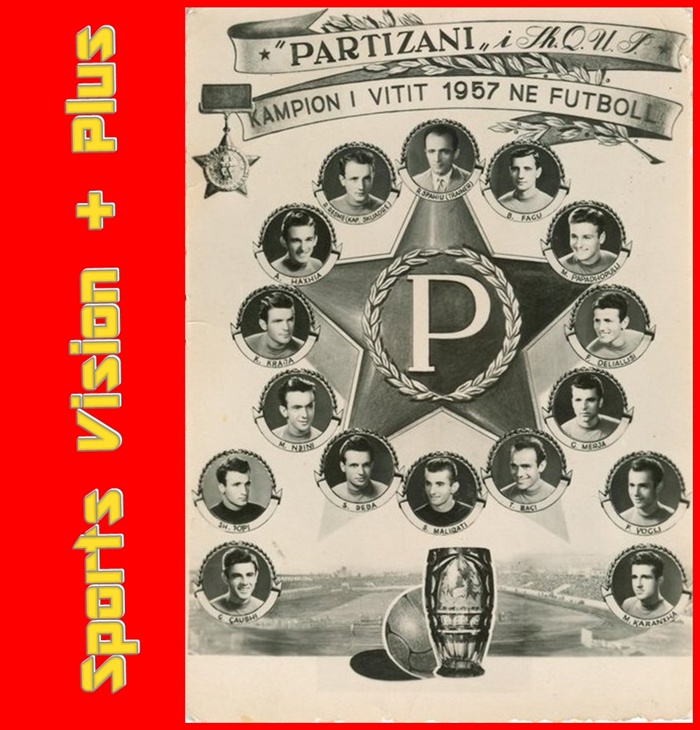
“Partizani”’s line-up and the players who stood out
A team that built its success on its own core
“Partizani” of Leipzig was not a team assembled temporarily with reinforcements from different clubs. In this tournament, the side relied on its own squad, with a core group of footballers who had played together and knew one another’s movements well.
The basic line-up appearing in the match records was:
Maliqati; Deliallisi, Fagu, M. Papadhopulli; Miço Ndini, G. Merja; Kolec Kraja, Bespalla, Robert Jashari, Refik Resmja, Simon Deda.
Other players also appeared during the tournament, including T. Shehu and R. Haxhiu.
Across five matches, “Partizani” scored a total of ten goals and conceded only four. Four of its victories came in the group stage and in direct knockout matches, while its only defeat was in the final.
Several names stood out in this team.
Refik Resmja was one of the central figures of the tournament. He scored four goals in “Partizani”’s five matches: two against “The Cong”, one against “Dukla” and one against “Vorwärts”. His goal in the 97th minute against “Dukla” was decisive in securing qualification for the semi-finals.
Resmja was a striker who combined technique, shooting ability and the capacity to take responsibility in decisive moments.
Miço Ndini was another protagonist. His goal against “CCA” of Bucharest gave “Partizani” victory and first place in the group. He also scored against “Vorwärts” in the semi-final. In addition to his attacking contribution, Ndini was part of a midfield core that helped the team maintain its balance.
Gani Merja was part of the same midfield structure and scored in the opening match against “The Cong”. His partnership with Ndini was among the elements that gave “Partizani” stability in its play.
Kolec Kraja contributed a goal in the 5-1 victory over “The Cong” and, through his attacking movements, helped create space for his teammates. His role on the wing was an important part of the team’s direct style of play.
Simon Deda scored the second goal in the semi-final against “Vorwärts”. He demonstrated the importance of alertness inside the penalty area and the ability to follow an attacking move through to its conclusion.
Robert Jashari was another important attacking player, scoring in the opening match and contributing to the team’s forward play. His presence helped ensure that “Partizani” did not depend on a single goalscorer.
At the back, Maliqati, Deliallisi, Fagu and M. Papadhopulli formed a defensive structure that kept the team competitive even against the opponents’ strong attackers.
Maliqati, who earned the nickname “Black Cat” for his performances and spectacular saves, was particularly important in closely contested matches, where a single mistake could change the fate of the entire tournament.
“Partizani”’s success was not the work of a single individual. Resmja and Ndini scored decisive goals, but reaching five matches and the final required an organised defence, a midfield capable of fighting for every ball and an attack that made the most of its opportunities.
At the helm of the team was coach R. Spahiu, who led a side that managed to preserve its core throughout a demanding schedule and against opponents with international experience.
Epilogue
What did Leipzig 1958 bring to Albanian football?
To understand the importance of this tournament, we must return to the reality of Albanian football in the 1950s.
Albanian clubs had their traditions, league rivalries and talented footballers. But opportunities to play regularly against high-level European teams were limited. For this reason, a tournament featuring teams such as “Dukla”, “CCA”, “Vorwärts” and “CDNA” offered a rare opportunity to measure the level of domestic football in a broader context.
“Partizani” was not content merely to participate. It won its group, eliminated “Dukla” after 120 minutes, defeated “Vorwärts” in the semi-final and reached the match for the trophy. These results were concrete evidence that the Albanian team could compete against strong opponents in important matches.
The tournament brought several important benefits to “Partizani” and Albanian football.
First, a genuine measure of its level. Facing teams with national-team players gave Albanian footballers the opportunity to test themselves against opponents with a high level of pace, experience and tactical discipline.
Second, experience in decisive matches. The victories over “Dukla” and “Vorwärts” showed that “Partizani” could maintain its concentration in situations where every mistake could mean elimination.
Third, increased confidence. Reaching the final after overcoming well-known teams was an experience that could influence the players’ self-confidence and the way Albanian football was perceived abroad.
Fourth, a model of collective preparation. “Partizani” relied on a group of players who knew one another well. In a short tournament with frequent matches, this continuity was an important advantage.
Nevertheless, it would be excessive to claim that a single tournament immediately changed all of Albanian football. Broader evidence concerning preparation, the league, training methods and the progress of clubs in the following years would be needed to support such a claim.
What can be said with certainty is that Leipzig in 1958 gave “Partizani” an extraordinary international experience and provided Albanian football with a strong point of reference for the level it could achieve.
The defeat in the final does not diminish this achievement. On the contrary, it places the story in its true proportions: “Partizani” was beaten by a strong Bulgarian team, but reached that match after overcoming four difficult obstacles.
Later, “Partizani” would continue to build its own history in Albanian football and win important trophies. But Leipzig remains one of the chapters demonstrating that the team had managed to compete with dignity on the international stage.
In September 1958, “Partizani” of Albanian Popular Army did not return with the gold medal. It returned with the silver of a tournament that had taken it all the way to the end, facing some of the strongest teams of the time.
And in the history of Albanian football, this silver carries the weight of a great achievement.
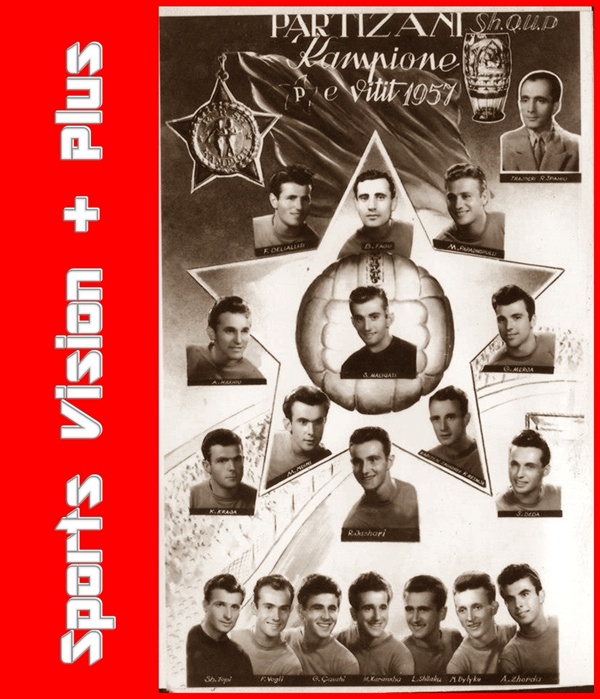
Third Unofficial Championship of Communist Countries
Army Clubs – 1958
CDNA SOFIJA-PARTIZANI TIRANË 1-0
Photo of final and all results of Leipzig Tournament 1958
(First Spartakiada/First Official Championship of Communist Countries Army Clubs)

Leipzig (former German Democratic Republic), September 28th, 1958: CDNA Sofija-Partizani Tiranë 1-0; attendance 100.000; Refik Resmja in action (no. 10: proclaimed best player of “Spartakiada”). Final of Leipzig Army “Spartakiada” (Champion Clubs Cup of Communist States): Partizani in second place.
Group 1 in Magdeburg:
Partizani Tiranë-The Cong Hanoi 5-1
(10′ Resmja, 14′ Merja, 16′ Kraja, 20′ Resmja, 80′ Jashari),
CCA Bucharest-The Cong H. 8-0;
Partizani T.-CCA B. 1-0
(70′ Ndini);
Table Standings:
1-Partizani UP. 4pts, 2-CCA B. 2pts, 3-The Cong H. 0pts
Group 2:
CDNA Sofia-Korean Army Pyeongyang 5-0,
CDNA S.-Ba Yi Beijing 3-3;
Korean Army P.-Ba Yi B. 2-0;
Table Standings:
1- CDNA S. 3pts, 2-Korean Army P. 2pts, 3-Ba Yi B. 1pts
Group 3:
Honvéd Budapest-Legia Warsaw 4-1;
CSKA Moskow-Legia W. 0-0;
CSKA M.-Honvéd B. 2-1;
Table Standings:
1-CSKA M. 3pts, 2- Honvéd B. 2pts, 3- Legia W. 1pts
Group 4:
Vorwärts Berlin (East)-Dukla Prague 2-1;
Table standings:
1-Vorwärts B. 2pts, 3- Dukla P. 0pts
Quarter finals
Vorwärts B.-Honvéd B. 3-0
CSKA M.-Korean Army P. 4-0
CDNA S.-CCA B. 4-0
Partizani T.-Dukla Praha 1-0
(aet: 113′ Resmja)
Semifinals
Partizani T.-Vorwärts B. 2-1
(35′ Ndini, 79′ Deda; in Berlin);
CDNA S.-CSKA M. 4-3
Final 3-4 place
Vorwärts B.-CSKA M. 2-1 (1-1)
Final 1-2 place
CDNA Sofia-Partizani T. 1-0 (0-0) (in Leipzig)
“Partizani UP. Albania kickers:
Tafil Baçi, Simon Deda, Besim Fagu, Fatbardh Deliallisi, Roza Haxhiu, Robert Jashari, Kolec Kraja, Sulejman Maliqati, Gani Merja, Miço Ndini, Miço Papadhopulli, Refik Resmja, Tomorr Shehu;
Coaches: Rexhep Spahiu, Sllave LLambi
FK PArtizani UP – Archival match records
of the 1958 Leipzig tournament
Match 1 – “Partizani” 5-1 “North Vietnamese Army”
Date: 19 September 1958
Location: Magdeburg, East Germany
Stadium: Magdeburg stadium; the official stadium name has not been confirmed in the records consulted.
Half-time score: 0-0
Full-time score: “Partizani” 5-1 “North Vietnamese Army”
Goalscorers:
• 55’ – Refik Resmja, 1-0
• 59’ – G. Merja, 2-0
• 61’ – Kolec Kraja, 3-0
• 70’ – Refik Resmja, 4-0
• 80’ – Robert Jashari, 5-0
• 82’ – Do, 5-1
Referee: Balla (Hungary)
Attendance: Not confirmed.
“Partizani” line-up: Maliqati; Deliallisi, Fagu, Papadhopulli, Ndini, G. Merja, Kraja, Bespalla, Jashari, Resmja, Deda.
“Partizani” coach: R. Spahiu.
“North Vietnamese Army” line-up: Duc, Phan, Quynh, Lai, Nam, Thang, Nghia, Anh, Tien, Do, Than.
Substitution: Thuong replaced Than in the 60th minute.
“North Vietnamese Army” coach: Trung Ban Buu.
Archival note: “Partizani” scored all five of its goals in the second half. The Albanian side scored three times in the first six minutes of its scoring run, turning a 0-0 match into a 3-0 lead.
Match 2 – “Partizani” 1-0 “CCA Bucharest”
Date: 21 September 1958
Location: Magdeburg, East Germany
Stadium: Magdeburg stadium; the official stadium name has not been confirmed in the records consulted.
Half-time score: 0-0
Full-time score: “Partizani” 1-0 “CCA Bucharest”
Goalscorer:
• 61’ – Miço Ndini, 1-0
Referee: Bergman (East Germany)
Attendance: 18,000
“Partizani” line-up: Maliqati; Deliallisi, Fagu, M. Papadhopulli; Ndini, G. Merja; Kraja, Jashari, Bespalla, Resmja, Deda.
“Partizani” coach: R. Spahiu.
“CCA Bucharest” line-up: Toma; Zavoda II, Nag, Staicu; Jenei, Onisie; Cacoveanu, Constantin, Alexandrescu, Zavoda I, Michaliescu.
Substitution: Bone replaced Michaliescu in the 60th minute.
“CCA Bucharest” coach: G. Popescu.
Archival note: Miço Ndini’s 61st-minute goal secured first place in the group for “Partizani”. Emerich Jenei, who would later become one of the best-known coaches in Romanian football, appeared in the Romanian line-up.
Match 3 – “Partizani” 1-0 “Dukla Prague”
Date: 23 September 1958
Location: Halle, East Germany
Stadium: The official stadium name has not been reliably identified.
Score after 90 minutes: 0-0
Final score after extra time: “Partizani” 1-0 “Dukla Prague”
Goalscorer:
• 97’ – Refik Resmja, 1-0
Referee: Jonescu (Romania)
Attendance: 20,000
“Partizani” line-up: Maliqati; Deliallisi, Fagu, M. Papadhopulli; Ndini, G. Merja; Kraja, Bespalla, Jashari, Resmja, Deda.
Substitution: T. Shehu replaced Kolec Kraja in the 32nd minute.
“Partizani” coach: R. Spahiu.
“Dukla Prague” line-up: Kouba; Safranek, Cadek, Novak; Dvorak, Masopust; Kordula, Brumovski, Benc, Borovicka, Kopamnicky.
Substitutions:
• Sura replaced Kordula in the 74th minute.
• Pavlis replaced Kouba in the 100th minute.
“Dukla Prague” coach: Kolsky.
Archival note: The match remained goalless after 90 minutes. Refik Resmja scored the decisive goal in the 97th minute of extra time, sending “Partizani” into the semi-finals.
Match 4 – “Partizani” 2-1 “ASK Vorwärts Berlin”
Date: 25 September 1958
Location: Berlin, East Germany
Stadium: Stadium in Berlin; the official stadium name has not been confirmed in the records consulted.
Half-time score: “Partizani” 1-0 “ASK Vorwärts Berlin”
Full-time score: “Partizani” 2-1 “ASK Vorwärts Berlin”
Goalscorers:
• 33’ – Miço Ndini, 1-0
• 79’ – Simon Deda, 2-0
• 85’ – Vogt, 2-1
Referee: Velcek (Czechoslovakia)
Attendance: 22,000
“Partizani” line-up: Maliqati; Deliallisi, Fagu, M. Papadhopulli; Ndini, G. Merja; R. Haxhiu, Bespalla, Jashari, Resmja, Deda.
Substitution: T. Shehu replaced Robert Jashari in the 60th minute.
“Partizani” coach: R. Spahiu.
“ASK Vorwärts Berlin” line-up: Spickenagel; Kalinke, Kiupel, Krampe; Unger, Herrmann; Assmy, Kaulmann, Vogt, Meyer, Wirth.
Substitution: Wachtel replaced Meyer; the minute of the substitution has not been confirmed.
“ASK Vorwärts Berlin” coach: R. Fritsche.
Archival note: “Partizani” reached the final after four consecutive victories. Miço Ndini scored the opening goal, and Simon Deda doubled the lead in the 79th minute. Vogt’s goal in the 85th minute made for a tense finish.
Match 5 – Final: “Partizani” 0-1 “CDNA Sofia”
Date: 28 September 1958
Location: Leipzig, East Germany
Stadium: “Leipzig Central Stadium” (Zentralstadion)
Half-time score: 0-0
Full-time score: “Partizani” 0-1 “CDNA Sofia”
Goalscorer:
64’ – Kiril Rakarov, 0-1
Referee: Aleksandër Wicz (Poland)
Attendance: 100,000, according to the published historical match record.
“Partizani” line-up: Maliqati; Deliallisi, Fagu, M. Papadhopulli; Ndini, G. Merja; R. Haxhiu, Bespalla, Jashari, Resmja, Deda.
Substitution: T. Shehu replaced R. Haxhiu in the 70th minute.
“Partizani” coach: R. Spahiu.
“CDNA Sofia” line-up: Naidenov; Rakarov, Manolov, Kovachev; Dr. Boshkov, Stojanov; Martinov, Dimitrov, Panayotov, Kolev, Janev.
Substitution: Milanov replaced Martinov in the 66th minute.
“CDNA Sofia” coach: Krum Milev.
Archival note: The final was decided by Kiril Rakarov’s free-kick in the 64th minute. “Partizani” finished the tournament as runners-up after four consecutive victories and a campaign that remains one of the significant international achievements by an Albanian club of that era.
© Copyright by Pjerin Bj
Bronx, New York: October 24-25, 2026
______________
Sports Vision +Plus since in 2013

Discover more from Sports Vision +
Subscribe to get the latest posts sent to your email.


