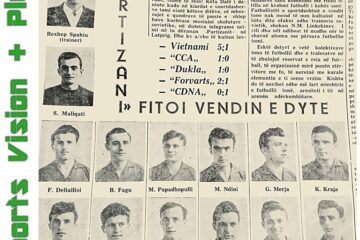
“The Red Beast” That Conquered the Balkans!
“Partizani” and the Summer of Glory 1970
 Prologue — A Team Built to Compete
In the spring of 1970, “Partizani” entered the Balkans Cup at an important moment in the club’s history. It was not a team seeking to discover its strength for the first time, but an established representative of Albanian football, with clear ambitions and a generation of players combining talent, experience and discipline.
One season earlier, “Partizani” had won the Albanian Cup and finished second in the 1968–69 national championship, behind “17 Nëntori”. Those achievements placed the club among the strongest teams in the country and encouraged it to look beyond domestic competition towards an international trophy.
The squad included some of the leading names in Albanian football: Panajot Pano, Sabah Bizi, Ramazan Rragami, Lin Shllaku, Safet Berisha, Astrit Ziu, Bujar Cani and Agim Janku. Under the guidance of Loro Boriçi, the team had developed an identity in which individual talent was expected to serve the collective effort.
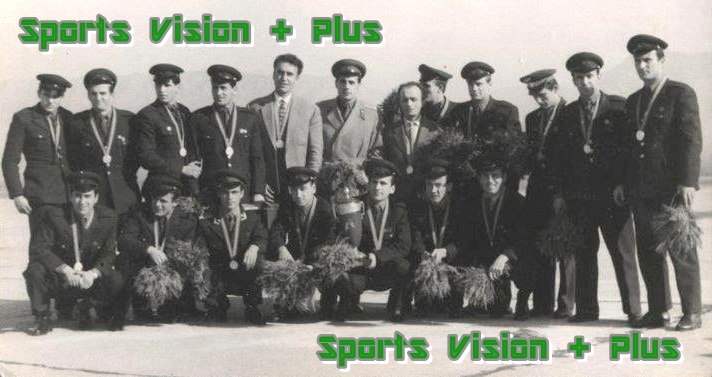
 “Partizani – UP”: (Up left to right) Suvorov SEFERI; Bujar CANI, Lin SHLLAKU; Loro BORICI (coach); Bashkim MUHEDINI; Safet BERISHA; ??? (Down left to right) Astrit ZIU; Vladimir BALLUKU; Gjergji THAKA; Agim JANKU; Sabah BIZI; Panajot PANO
Pano represented the striker’s instinct, technique and ability to decide a match with a single action. Bizi brought vision, creativity and intuition to the construction of attacks. Around them, the midfield, defence and the rest of the squad completed a mechanism built on cooperation and tactical preparation.
In Group B of the Balkans Cup, “Partizani” would face “Sloboda” of Tuzla and Romania’s “Universitatea Craiova”. The club’s reputation and the players’ individual abilities would not be enough. Qualification had to be earned on the pitch.
And that was where the journey towards glory began.
Four Matches on the Road to the Final
Tuzla: The First Step
On 15 April 1970, “Partizani” began its campaign away from home against “Sloboda”, at “Tušanj Stadium” in Tuzla. The match ended 1–1, with Panajot Pano scoring for the Albanian side.
The draw was a valuable point in a difficult away fixture. It did not settle the qualification race, but it allowed “Partizani” to build its campaign one step at a time. In a short competition, where every goal could carry decisive weight, maintaining balance and avoiding unnecessary setbacks were essential.
Tirana: Agim Janku Opens the Way
On 6 May, “Partizani” hosted “Universitatea Craiova” at “Qemal Stafa” Stadium in Tirana. It was a closely contested match, decided by Agim Janku’s goal in a 1–0 victory.
The scoreline was narrow, but the result was important. “Partizani” collected the points and showed that it could win matches in which space was limited and a single mistake could prove costly.
The connection between Bizi, Pano and Janku represented three essential qualities: creativity, finishing and the ability to turn an attacking move into a result. Behind every decisive moment, however, stood the work of the entire team.
Craiova: The Victory That Changed the Outlook
On 27 May 1970, “Partizani” travelled to Romania to face “Universitatea Craiova” again, this time at “Central Stadium”. The Albanian side won 1–0 away from home, with Agim Janku scoring in the 37th minute.
The victory had enormous significance for the group standings. “Partizani” was no longer relying solely on home advantage; it was demonstrating that it could obtain results away from Tirana, even when the opposition had the responsibility to take the initiative.
The two victories over “Universitatea Craiova” would become the foundation of qualification. At the end of the group stage, that record would help the Albanian side finish ahead of its rivals.
The Race Against “Sloboda”: When the Numbers Decided
The other group matches kept the contest open. “Sloboda” and “Universitatea Craiova” drew 2–2 in Tuzla and 1–1 in Craiova, leaving “Partizani” in a position where qualification would depend on the overall results.
On 1 July, at “Qemal Stafa” Stadium in Tirana, “Partizani” faced “Sloboda” for the second time. The match ended 2–1 in favour of the Tuzla side. Panajot Pano scored for the hosts, but the visitors secured the victory.
The defeat was a setback, but it did not erase the work completed in the earlier matches. At the end of the group stage, “Partizani” and “Sloboda” had five points each. The Albanian team recorded two wins, one draw and one defeat, scoring four goals and conceding three.
“Sloboda”, meanwhile, finished unbeaten, with one win and three draws, scoring six goals and conceding five.
Qualification was decided by the goal-average ratio. “Partizani” recorded a coefficient of 1.333, compared with 1.200 for “Sloboda”. It was a small difference, but a decisive one.
Thus, “Partizani” secured its place in the final. Qualification had not been handed to the Albanian side: it was the outcome of four matches, two victories over “Universitatea Craiova” and a record that proved more favourable than that of its main rival when the final calculations were made.
The Final — “Partizani” Faces the History of “Beroe”
Stara Zagora: A Different Albanian Team One Year Later
On 9 August 1970, “Partizani” took the field at “Beroe Stadium” in Stara Zagora for the first leg of the final. Its opponent was “Beroe”, the Bulgarian side that had won the Balkans Cup a year earlier after a dramatic final against Tirana’s “Dinamo”.
In 1969, “Dinamo” had left the field in the closing minutes of the second leg following a refereeing decision to award a penalty. The match was awarded to “Beroe” by an administrative score of 3–0, giving the Bulgarian team the trophy.
Now, one year later, in the same city and against the same opponent, it was the turn of another Albanian representative.
But “Partizani” had not travelled there to play the role of a memory from the previous season. It had earned its place in the final through its own results and was ready to challenge the reigning holders.
The squad included Pano, Bizi, Rragami, Shllaku, Berisha, Ziu and a group of players shaped by domestic competition and tactical discipline. Under Loro Boriçi, the team had developed a character that combined talent with collective responsibility.
This is where the metaphor of the “Red Beast” takes shape. Not as a symbol of an unbeatable team, but as the portrait of a side prepared to fight, preserve its organisation and refuse to abandon its objective when faced with adversity.
And “Beroe” knew that it was facing a different “kind of beast,” one with a character that would not back down so easily, but instead fought every battle with courage and composure, determined to achieve its goal, while giving its opponent the unmistakable impression that it was facing a relentless warrior who would fight to the very end.

If the 1969 final had become associated with a dramatic departure from the pitch, “Partizani” intended to write its own story through a different attitude: facing the challenge and pursuing the trophy to the very end.
Bizi Strikes First
At “Beroe Stadium”, “Partizani” did not simply defend its hopes. It sought the lead and found the breakthrough through Sabah Bizi.
The first half ended 1–0 to the Albanian side, but “Beroe” equalized and the match finished 1–1. The result gave “Partizani” a favorable position ahead of the return leg in Tirana. The Albanian side had scored away from home and demonstrated that it could compete with the reigning holders without retreating from the challenge.
Bizi was central to a decisive moment, but this final was not the work of one player alone. Behind him stood an organised team in which every player had a role to fulfil and the collective balance had to be maintained in a match of historical importance.
For the second time in a year, the Balkans Cup was to be decided between “Beroe” and an Albanian team. This time, however, the story was moving towards a different conclusion.
Tirana: The Trophy Is Decided Administratively
On 16 August 1970, “Qemal Stafa” Stadium in Tirana was scheduled to host the second leg. “Partizani” was ready to complete the job on home soil, but “Beroe” failed to appear.
As a result, “Partizani” was awarded a 3–0 administrative victory. Combined with the 1–1 draw in the first leg, this produced a 4–1 aggregate result and made the Albanian side the winner of the 1970 Balkans Cup.
 An important distinction must be made: “Partizani” did not win 3–0 in a match played on the pitch. The game did not take place because the opposing team failed to appear. Nevertheless, the administrative ruling became part of the official final result and determined the winner of the trophy.
Here lies the irony of the story. A year earlier, “Beroe” had benefited from a final interrupted after “Dinamo” left the field; this time, the Bulgarian side itself failed to appear for the decisive return match. The circumstances were not identical, but the outcome was clear: the 1970 trophy went to Tirana.
“Partizani” had earned its place in the final on the pitch, drawn away from home and entered the return leg with a genuine opportunity to win the cup. “Beroe”’s failure to appear brought the competition to an administrative conclusion, but it did not erase the journey the Albanian team had completed to reach that point.
Epilogue — When the “Red Beast” Ruled the Balkans
In football history, some trophies are won with a last-minute goal, some through an extraordinary comeback, and others after a sequence of matches in which patience, organisation and calculations carry as much weight as talent.
The 1970 Balkans Cup became part of that history.
“Partizani” began with a draw in Tuzla, won twice against “Universitatea Craiova” and ended the group stage with a defeat against “Sloboda”. But when the points were added and the goals calculated, the Albanian side finished ahead of its rival and secured a place in the final.
In Stara Zagora, Bizi scored in the first leg and “Partizani” returned to Tirana with a 1–1 draw. Then came “Beroe”’s failure to appear and the administrative 3–0 victory. The aggregate score of 4–1 was confirmed, and the trophy was awarded.
The metaphor of the “Red Beast” suits this team not as a claim of invincibility, but as a symbol of its character: a disciplined side, built for competition and capable of keeping its objective in sight even when the road towards it was neither straightforward nor predictable.
At the heart of this story was a generation of outstanding players. Panajot Pano brought the instinct and technique of an exceptional striker; Sabah Bizi was one of the team’s creative minds; Agim Janku scored the two decisive goals against “Universitatea Craiova”; while Ramazan Rragami, Lin Shllaku, Safet Berisha, Astrit Ziu and their teammates formed the backbone of a team built on cooperation and discipline.
Under Loro Boriçi, “Partizani” ended 1970 with an achievement that reached beyond domestic football.
Winning the Balkans Cup remains one of the most important chapters in the club’s international history and a testament to the generation that carried Albanian football to a regional trophy.
In the summer of 1970, the “Red Beast” “Partizani” did not walk away from the pitch. It completed its journey as champion of the Balkans.
ARCHIVAL TABLE
All “Partizani” Matches in the 1970 Balkans Cup.
Match 1
“Sloboda” – “Partizani” 1–1
Date: 15 April 1970
Location: Tuzla, Bosnia / Yugoslavia
Stadium: “Tušanj Stadium”
Attendance: 3,000
Referee: —
Goalscorers: Panajot Pano 18’; Mustafa Hukić / Ešref Jusić —
Line-ups:
“Partizani”:
Bashkim Muhedini; Vladimir Balluku, Safet Berisha, Bujar Cani, Astrit Ziu; Lin Shllaku, Sabah Bizi; Agim Janku, Panajot Pano, Sotir Seferaj, ????.
Match 2
“Partizani” – “Universitatea Craiova” 1–0
Date: 6 May 1970
Location: Tirana, Albania
Stadium: “Qemal Stafa”
Attendance: —
Referee: —
Goalscorer: Agim Janku 82’
Line-ups: —
Match 3
“Universitatea Craiova” – “Partizani” 0–1
Date: 27 May 1970
Location: Craiova, Romania
Stadium: “Central”
Attendance: 20,000
Referee: —
Goalscorer: Agim Janku 37’
Line-ups: —
Match 4
“Partizani” – “Sloboda” 1–2
Date: 1 July 1970
Location: Tirana, Albania
Stadium: “Qemal Stafa”
Attendance: 25,000
Referee: —
Goalscorers: 1–0 Panajot Pano / 1–1 Aleksandar Miličić (penalty) / 1–2 Jusić
Line-ups
“Partizani”: Mikel Janku; Vladimir Balluku, Safet Berisha, Bujar Cani, Astrit Ziu; Lin Shllaku, Sabah Bizi; Agim Janku, Panajot Pano, Sotir Seferaj, Flaku.
Coach: Loro Boriçi.
“Sloboda”: Rizah Mešković; Časlav Jevremović, Faruk Pašić, Đorđe Gerum, Aleksandar Miličić, Mesud Nalić, Mustafa Hukić, Omer Jusić, Tihomir Trifunović, Ešref Mujezinović, Dušan Jovanović.
Coach: Josip Duvaničić.
Final — First Leg
“Beroe” – “Partizani” 1–1
Date: 9 August 1970
Location: Stara Zagora, Bulgaria
Stadium: “Beroe”
Attendance: 12,000
Referee: Gheorghe Limona (Romania)
Goalscorers: Bizi (P) ;
Line-ups: —
Final — Second Leg
“Partizani” – “Beroe” 3–0
(awarded by administrative decision)
Date: 16 August 1970
Location: Tirana, Albania
Stadium: “Qemal Stafa”
Attendance: —
Referee: —
Goalscorers: Administrative award, 3–0
Line-ups: The match was not played.
Final record
• Group matches: 4
• Group record: 2 wins, 1 draw, 1 defeat
• Group goals: 4 scored, 3 conceded
• Group points: 5
• Goal-average coefficient: 1.333
• Final: 1–1 away, followed by a 3–0 administrative victory in the return leg
• Aggregate final score: 4–1
• Trophy: 1970 Balkans Cup winners
Archival note: The return match against “Beroe” is recorded as an administrative victory, not as a match played on the pitch.
© Copyright by Pjerin Bj.
Hudson Yard, New York City: October 27, 2026
________
Sports Vision +Plus in activity since 2013

Discover more from Sports Vision +
Subscribe to get the latest posts sent to your email.