1983 | The Eagles Soar Over the Alps: West Germany Left Out, Albania in the European Top 8!

A new generation knocking on the door
The beginning of the 1980s was not an easy period for Albanian football. The senior national team continued to face the wide gap separating it from the European powers, while results against teams such as West Germany and Austria showed that the road to the top was still a long one. In the qualifying campaign for the 1984 European Championship, the “National Team” finished its group in last place, even though it included outstanding players of Albanian football.
But beneath this facade, something was moving.
Albanian clubs were producing a new generation of footballers.
“17 Nëntori,” “Dinamo,” “Partizani,” “Vllaznia,” “Flamurtari,” “Labinoti,” “Luftëtari” and the other clubs were supplying the representative teams with young men who had not come simply to make up the numbers.
These clubs were bringing a new generation of footballers into the light. Young men, quick feet, strong lungs and a hunger to show that Albania, too, could have its own golden sons of football.
They were coming to take their place.
And this is precisely where we must look for the origins of that
“Shpresa U21” which, a few years later, would shake European football.
Mersini, Zmijani, Hodja, Jera, Oçelli, Canaj, Demollari, Josa, Vila, Topçiu and the others were part of this new wave, which was not a team detached from the reality of Albanian football. It was the sum of the talent emerging from the domestic championship. They did not come from Europe’s luxurious academies, but from the fields of the Albanian championship; they were “Made in Albania,” forged in a football modest in resources, but rich in character.
At their head was Ramazan Rragami, with Petraq Ikonomi, and in the autumn of 1982 this generation began its European journey.
And what a journey!
This generation of young men began to take the shape of a team that knew no fear. They were still young eagles, but their wings were growing with every match.
The 2–1 victory in Austria was the first signal. Then came the 1–0 win in Manisa against Turkey. Then 1–1 with West Germany in Shkodër. Then the victories over Turkey and Austria. It was no longer a coincidence. It was a generation that had begun to believe in its own strength.
Four wins. Two draws. No defeats.
Ten points.
Albania at the top of the group.
West Germany behind them.
A “Shpresa U21” that was no longer waiting to become great.
It had begun to believe that it already was.
And now, in front of them, was West Germany.
No longer a mountain to be watched from afar, but the summit that had to be climbed.
Trier: the night Albania entered another dimension
German Soil Trier.
The stands of the “Moselstadion” were filled with more than 19,000 spectators. On the field, West Germany had come to do what seemed natural: win and take the ticket to the next round.
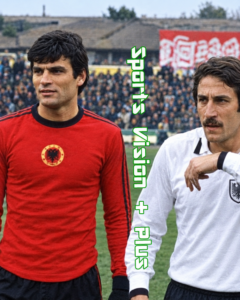
Albania, on the other hand, had come to protect a point worth as much as a passport into history. Among the German supporters, the red-and-black flags of Kosovo Albanians and Albanian emigrants in Germany gave the stadium another color.
Berti Vogts had sent an aggressive team onto the field. Four forwards against an Albanian defense that had to become a wall.
And for many minutes, that wall stood firm.
Mersini was alert in goal, while Hodja and Jera led a defensive unit that left no opening. In the 30th minute, Albania even came close to scoring on a counterattack through Sefedin Braho. It was a small warning that these young men had not come to Trier simply to count the minutes.
Then came the German blow.
Minute 38.
A free kick. The ball rises into the box. Michael Rummenigge breaks free and heads it home.
1–0.
For a moment, it seemed as though the door to the European top eight was closing in front of Albania.
But these young men had come this far for a reason.
And they did not know how to surrender.
Just a few minutes later, Albania won another free kick. A. Canaj sent the ball toward the box and there appeared M. Josa with a header.
Into the net.
1–1!
In the 40th minute;
By now, one thing does not change: Albania immediately responded to West Germany, like a team that had not come to Trier to be intimidated by the name of its opponent.
The second half was a battle of nerves.
The Germans were looking for the goal that would keep them alive. The Albanians were defending not only the result, but the dream of a generation.
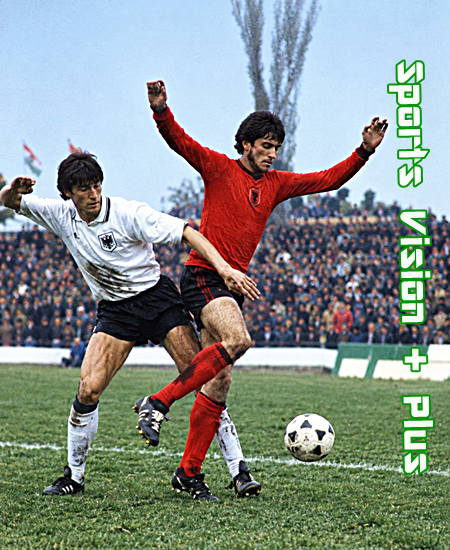
Every tackle was a step toward the top eight. Every save by Mersini, one more breath. Every ball cleared by the Albanian defense, another piece of the wall being built in front of the goal.
And the minutes passed.
West Germany could not find another goal.
When the final whistle came, in Trier there was no longer an Albania looking to survive.
A new Albania had been born, one that had learned to face the giants.
1–1.
West Germany out. Albania in the European top eight.

And on that German evening, a flock of young Albanian eagles had just discovered that their wings were much stronger than they had thought.
Hugs, tears of joy for the historic draw and qualification, achieved as never before until then, were the final act closing the curtain on this performance by the U21 “Shpresa,” a completely Albanian creation.
For more info about Albanian “Shpresa” Under 21 European Championship, the link below: https://www.sportsvisionplus.com/made-in-albania-albania-u21-in-the-best-eight-in-europe/?utm_source=chatgpt.com
© Copyright by Pjerin Bj
Bronx, New York: September 21, 2026
________________-
Sports Vision +Plus | Champions Hour in activity since 2013

Discover more from Sports Vision +
Subscribe to get the latest posts sent to your email.